Editorials
[BEST & WORST ’11] The 7 Biggest Surprises of the Year!


Oh hey, I didn’t see you there!
2011 was an eventful year – tectonic shifts are moving through the industry in terms of distribution methods, audience demand, and the staggeringly precipitous drop off in quality of studio releases.
When I sat down to write this piece I didn’t want to make a laundry list of complaints (or praise), but rather a collection of stuff – good or bad – that genuinely surprised me at the time. Even if much of it does make sense now.
Also, I’m not sure whether this particular piece is getting published before or after my Best Posters & Worst Trailers lists – but both of those were written beforehand and mention Red State.
Why do I bring this up? Because this editorial contains my final word on Kevin Smith and his Red State shenanigans. Sure, I reserve the right to speak up if there’s something else to contribute to the conversation – but I’m making a vow to wash the taste of Kevin Smith (2011 Edition) out of my mouth. That means that – after this article – I’m giving him a clean slate. I’d like to be pleasantly surprised by him after an unpleasant 2011.
Hit the jump to check it out!

Micah (Best/Worst) | Lonmonster (Best/Worst) | Evan Dickson (Best/Worst) | Lauren Taylor (Best/Worst)
Posters (Best/Worst) | Trailers (Best/Worst) | Performances (Best)
The big horror film this past April was supposed to be Scream 4. It wasn’t. In fact, the public displayed a markedly decreased interest in the continuation of the franchise (either because of Scream 3 or the simple passage of time, take your pick). What the public decided upon instead was Insidious. A film that wasn’t really on the world’s radar in any big way prior to its release wound up taking in $54 Million domestic ($97 Million worldwide) at the box office. Compare that with Scream 4’s disappointing domestic haul of $38 Million ($97 Million worldwide) and you might ask what the big deal is. After all, their worldwide cumes are nearly identical. Of course, the $1.5 Million budget for Insidious is roughly 1/26th of the amount spent on Scream 4. And the budgets allocated to their P&A campaigns were of disparate amounts as well (though not as dramatic of a divide as their production costs). What Insidious proved, however unlikely or temporarily, is that audiences on occasion will choose something small and original over sequelized behemoths. In this day and age, that’s a nice surprise to have.

The Thing – $16,928,670*
Fright Night – $18,302,607*
Straw Dogs – $10,324,441*
*domestic box office
First of all, I’m calling The Thing a remake even though technically it’s a prequel. But it’s a prequel with the same title, an identical visual aesthetic and no new ideas. The reason it exists is for the same business reasons remakes exist. At the core of its CGI heart, spiritually, the film is a remake and you know it.
Why did they fail? I never expected Straw Dogs to knock it out of the park. The subject matter is wayyyyyy too touchy and its leads, while all appealing actors, have yet to be proven box office draws.
But I honestly thought The Thing and especially Fright Night would do better. Even if Colin Farrell is more of a character actor than movie star these days it had a great cast, decent marketing and it’s about vampires (the cash cow with golden udders). The Thing looked like it was positioned to sucker in a great October opening weekend at the very least.
In hindsight the two-pronged explanation seems relatively simple.
None of these movies were all that great. Maybe horror audiences are getting better at parsing through marketing and ascertaining an approximation of the actual quality level of the film.
…and…
As much as you and I may love the original films, none of them were really hits. Even though they’re all classics with rich lives on the video shelves, there’s not really a giant mainstream awareness of them. Especially among teenagers. This lack of awareness hurts on two fronts. You don’t get the “built-in-audience” factor that remakes bank on, and the few people who do make it to the theater without being in love with the originals are confronted with films that spend much of their running time paying attention to a different audience. Case in point, the ending of The Thing. As a fan of the original it was one of the few moments I appreciated. But if you’re some kid who walked in blind? What the hell are you supposed to do with that?

Spoiler! If I told you that there was a film with an ensemble cast that took place in a mental hospital and asked you to guess the twist ending – what would your first guess be?
That’s right! That’s exactly what it is. I’m not sure what John Carpenter saw in Michael and Shawn Rasmussen’s script, other than something he could shoot on the cheap. The shame is that Carpenter actually kind of brings it here as a director – the film is visually and editorially sound. Unfortunately it’s saddled with a script straight from the 1992 “consider” pile.

I’m not sure what went wrong in the minds of horror fans on February 25th, 2011. But it was more than a little surprising to see so few of you turn out for Drive Angry. Nic Cage having intercourse mid gunfight, William Fichtner in general, the devil, cars, blood, car chases, Amber Heard… need I go on?
It’s not a classic, but this is one of those original movies that you constantly whine about not getting, only to routinely reject.

It can be such a pain going to see short films. You want to do it out of an inherent duty to keep your eye out for special new talent, but you get burned again and again. Shorts are the great canvas for people who aren’t ready to make films to announce to the world just how unprepared they are. I saw at least 50 or 60 shorts this year and I think I liked maybe 5 of them.
Then there’s Cost Of Living. It’s a load of fun and it’s also writer/director BenDavid Grabinski’s announcement that he’s ready for the reigns on a feature. Filmed in a tunnel system familiar to any fan of They Live, this short packs more character, humor, action and gore into its 8 minute running time than many of the features I had to sit through this year. Particularly inspired is the computerized voice of the automated security system – a device that simultaneously ups the tension and the laughs.
Look for Cost Of Living to make its online debut sometime next year.

September 9th, 2011.
Despite the fact that it should have never been made at all, Creature opened on a whopping 1,507 screens on this date. Regardless of the realities of the situation, the only way I can imagine this decision playing out is in a dank room with flickering lights and gargantuan quantities of cocaine.
I saw the film the night before its release in a room filled with the most odious moviegoers I’ve ever had to endure. Cell phones constantly on, the guy behind me drinking a 40, the entire audience refusing to shut the f*ck up. Normally I call people out on this behavior but it was a toss-up for me since their bored commentary about equaled the movie in entertainment value. I came to the conclusion that if the entire theater went up in flames, taking the audience and a print of the film with it, it would totally be worth the sacrifice of my own life.
Of course, reality rewarded them with the 2nd lowest wide release per-screen average in the history of cinema – but I’m still really curious as to how they arrived at this decision. Shortly after the film’s release, director Fred Andrews called critics who didn’t like the film (ie everyone except for the LA Times) “bottom feeders”. This being despite his inept audacity to have his entire climactic battle take place off camera.
So from a “bottom feeder” to Fred Andrews – how’s the view from the top buddy?

After lying to legitimate bidders at the Sundance Film festival about his intentions to auction off the rights to his middling bible belt thriller, Smith smugly strolled out in his trademark oversize hockey jersey and ‘bought’ the rights to the film himself for $20. It was a moment choreographed to come across as bold and triumphant. Well, he misread the room – many of whom had actually been considering buying Red State. Instead it spoke volumes about Smith’s own disconnect with growth, valid criticism. More loudly still, it spoke about Smith’s increasing need to insulate himself.
Smith has been at odds with critics since Cop Out (and you could argue that he’s been at odds with quality filmmaking since Jay And Silent Bob Strike Back) when he suggested they have to pay to see his films like everyone else. It was also around this time that he curiously defended Cop Out by implying that the title of the film alone should clue us in to the amount of effort he put into it. In which case it makes no sense for him to get mad about people hating it, but very little about Smith makes sense these days unless you view it through the lens of impotent rage.
So to see him four-walling his Red State and taking it on the road at premium prices (*some markets had tickets below $80, some markets had ticket above $80) along with a Q&A segment almost makes sense in terms of his overall trajectory. He also charged $20 dollars to see it at the New Beverly, a venue that almost always offers double features along with Q&A for $7. The iTunes rental started off at $9.99, which is a good deal more than most premium rentals.
That’s not surprising. What’s surprising is how ugly it got.
Look, he knows how to get his fanbase to shell out inordinate sums of money. There’s always been a ceiling of $30 Million or so for his films DBO and it’s a smart move on his part to recognize that he’s trapped under a glass ceiling. But he does have a large number of fans under that ceiling with him that worship the ground he walks on and will pay top dollar for anything he does. It’s a cynical move on his part to exploit that, but it’s also smart. I feel bad for his fans, but there’s only so many times you can try and intervene in an abusive relationship before you realize you’re just wasting everyone’s time.
But it gets uglier beyond that – perhaps emboldened by his perception of the success of a new business strategy that allows him to keep his friends in his pocket while alienating his ‘enemies’ (anyone he perceives as having done him wrong – which after 20 years in the business is a long, long list) – he has begun dismantling any and all remaining goodwill towards him. He has a security blanket in the cadre of fans who suck up to him on twitter, forwarding him links of articles they feel have wronged their master in an attempt to solicit approval for themselves and ire towards anyone who refuses to validate their aesthetic arbiter (in some cases their lifestyle arbiter).
In some ways he’s becoming the geek Howard Hughes, withdrawing into his own world. Instead of germs, he’s battling criticism. It doesn’t matter whether it’s overt or implied. In what seems like a subconscious act of grappling with his insecurities, rather than demanding accolades for himself, he’s decided to throw his actors into the firing line instead (something I suspect they want no part of). After all, the series of screenings at the New Beverly was an “Award Qualifying” run for his talent… not for him.
A few weeks ago, the Independent Spirit Awards failed to recognize Red State in a manner that lived up to Smith’s expectations.
His response? “How the fuck did the @SpiritAwards NOT nominate Michael Parks? Nor John Goodman? Nor Melissa Leo? Fuck your idiotic organization.”
In a world defined by our actions, he’s that kind of guy now. It’s enough to retroactively spoil what little enjoyment I still get out of his early films.
In order to grow as a filmmaker you need to learn from your mistakes. Which is perhaps why Smith isn’t showing any growth. Sure, he self-deprecatingly admonishes himself and his films, but I don’t think he actually internalizes what he’s saying. It’s just fodder for the Q&A circuit, fodder for Kevin & Bean, and fodder for the people who he knows will buy what he’s selling.
I hope he gets past this, I hope this is a phase. But I’m beginning to think this is how he’s been all along.



College kids, strippers and vampires—those were Donald P. Borchers’ only requirements when he approached Richard Wenk about writing and directing a movie for New World Pictures. As requested, Wenk cooked up Vamp (1986), a tailor-made blend of the decade’s teen movie craze as well as its horror boom.
Grim and earnest stories were still very much a part of the ’80s horror landscape, yet Vamp is something of a comedy. One difference between it and, say, Saturday the 14th, though, is the former avoids using schtick. Wenk’s movie proves that horror comedies also don’t have to subtract thrills from their recipes. Of course, it takes a minute before reaching that point; college antics and culture shocks preface this one macabre misadventure.
Vamp‘s initial setup is apt for a typical college-set, sex-driven comedy; to bribe their way into a fraternity house, two pledges (Chris Makepeace, Robert Rusler) go looking for some adult entertainment. Without wasting time on any further exposition, the characters embark on an all-in-one-night trip that quickly detours into terror.
To procure their elusive MacGuffin—a stripper willing to gyrate for some frat boys—Keith (Makepeace) and AJ (Rusler), plus a third wheel named Duncan (Gedee Watanabe), trade the safety of their remote college campus for the seediness of some unnamed city. The setting is recognizably L.A. by day, but as soon as night falls, downtown, along with the characters, slips into a kind of surreal universe. Director of photography Elliot Davis gave this early entry on his prolific résumé an unusual yet distinctive look; that Mario Bava-esque, magenta-green lighting is omnipresent, so much so that it’s almost its own character.

Chris Makepeace and Robert Rusler in Vamp
The faint comparisons to Martin Scorsese’s After Hours are merited, although not just because of Vamp’s distinguishing nighttime aesthetic. Save for the primary characters, the supporting roles in Wenk’s movie are also quite colorful and transactional in their behavior. The difference here, though, is the additional urge to ruin Keith and his friends at every turn. Some of that harm is humorous and tolerable enough, whereas the moment Vamp dishes out its first fatality, it’s abundantly clear how this movie qualifies as horror.
Vamp falls into that category of horror movie that reveals its genre with a scream rather than a series of whispers. The opening scene can function as a hint of what lies ahead—things are not at all what they appear to be—but otherwise, Wenk is more than happy to hold off on the horror. When that time does come, though, it catches the viewer off guard. In addition to the pure shock value is that sudden decision to upend the movie’s foremost feature. Or so it would seem.
If afraid of major spoilage, those new to Vamp would be wise to stop reading here. There’s just no skirting around the fact that the central fellowship in this buddy movie hits a serious snag when AJ is killed. That development causes the story to become more of a “long, bad night” journey for Keith and his romantic interest. So while Wenk scores points for subverting expectations, there is also a touch of sadness in his decision. Because if Vamp does anything well, it’s making the characters likable.
Something that comes easily to Vamp—and other teen horror movies from this same era—is its ability to invent young characters worth caring about, or at the very least, are interesting and not so immediately off-putting. More impressive is how Wenk did all this without actually fleshing out those characters. Still and all, Keith and his kind are a grade above cookie-cutter, and in some cases, aren’t completely devoid of growth.

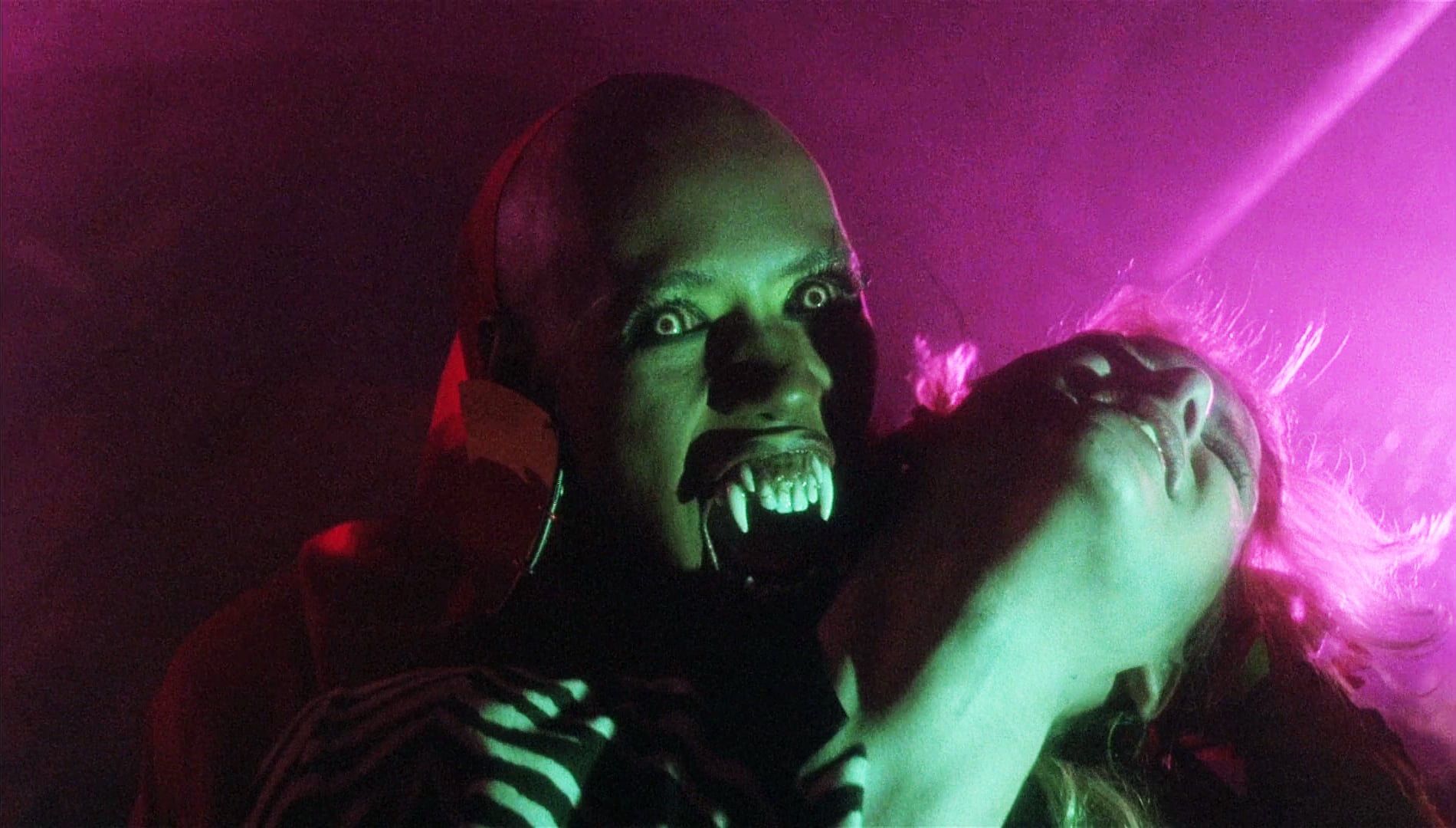
Grace Jones in Vamp
Vamp appeals with an assorted cast of characters. No two are the same, nor are they operating on the same wavelength. The cinematically extroverted AJ, whose actor conveyed charm and vulnerability in near equal amounts, comes alive when he’s at his most undead. Makepeace then makes the chronically cautious Keith a sympathetic fellow, even as he’s more and more affected by the night’s bizarre events. Meanwhile, Duncan is indeed the designated loser of the whole bunch, but Watanabe still manages to humanize him. As a bonus, the role didn’t require him to pull a Long Duk Dong.
As for Dedee Pfeiffer, she is plain adorable as the mysterious After Dark server nicknamed “Amaretto”. She spends all night fixing her dress strap while at the same time trying to get Keith to remember how he knows her. As their offbeat romance grows, it becomes another highlight of this movie. Whether or not Pfeiffer’s character is really a vampire also creates some welcome tension in the story.
Like a lot of its contemporaries, Vamp went on to become a bit of a cult classic. That current status is determined by several factors, but without a doubt, the casting of Grace Jones is the most considerable. The image of her writhing on that unique-looking chair, a Keith Haring original, springs to mind whenever this movie is brought up.

Chris Makepeace, Billy Drago and Paunita Nichols in Vamp
Prior to that first display of unequivocal horror, local vampire queen Katrina (Jones) took to the stage and delivered a strip show like no other. One would expect nothing less from that renowned model and performance artist. By now reports of Jones’ tardiness on set are no secret, yet it’s also hard to deny her commitment to the part of Katrina. It was, in fact, Jones who took charge of her character’s appearance—on top of Haring painting her body and that now-iconic chair, she had Andy Warhol handle her costuming. And not too many actors could seize a room’s attention without saying a single line of dialogue.
In 2022, Vamp received a retrospective novelization from Encyclopocalypse. This literary union of preexisting source material—Wenk’s original screenplay—and new ideas from author Christian Francis amounts to a more comprehensive visit to the After Dark Club. The basic story there is no different than what’s shown on screen; however, Francis gets creative with the characters’ origins and designs, and he enhances a number of key scenes.
The novelization expands on the urban and social decay of the main setting, and supplies a background for the After Dark Club. Sandy Baron’s character, Katrina’s emcee and familiar, is given ample motivation for sticking around; up until the fiery end, he is loyal to his friend and former business partner “Squeak”, who looks like he was “fed through a combine harvester, and left as nothing more than a heap of mangled remains”. Then there is Billy Drago’s character Snow, the leader of a street gang called The Dragons. His reason for menacing Keith and AJ is more altruistic than in the movie; he and his peers act tough to scare off any potential food for the vampires.

Lisa Lyon in Vamp
If not for all the backstories, Francis’ Vamp would be a hell of a lot shorter. Instead, this tie-in read dives into how AJ met Keith—the orphaned Anthony Joseph hailed from a broken home back in Brooklyn—and how their friendship flourished over the years. Keith’s archership is no longer just an assumed part of his entire being; it’s a confidence-building extracurricular for a boy who got picked on before coming into the protection of the new kid in town. These supplemental, in-depth looks at the protagonists, plus their close connection, are maybe unnecessary. The movie already did a fair and concise job of addressing their platonic intimacy without the need for flashbacks and insights, specifically in that scene where AJ lays it all out as he sacrifices himself.
Where the novelization gets off course is its approach to the minor characters. Intermittently backstorying the likes of Katrina’s indentured servants, Seko (Leila Hee Olsen) and Vlad (Brad Logan), ends up disturbing the flow of the writing. Was it absolutely essential that readers know Vlad was the Grand Duke of the House of Romanov, or how Snow’s accomplice Maven (Paunita Nichols) became so dentally challenged? No, not really. However, one’s mileage with these random biographies may vary.
The novelization is a more substantial experience, but for a movie like Vamp, less is more. And as plentiful as they are, it never simply coasts on its campy charms, either. The character work sits comfortably in that realm between cursory and meticulous, the script is sharper than first realized, and Greg Cannom’s vampire makeup is straightforward yet effective. Most of all, the movie didn’t squander its out-of-the-box concept. Richard Wenk made his vision of a “comic nightmare in which just about anything that can go wrong does” come true, and it is very enjoyable.

You must be logged in to post a comment.