Editorials
Looking at the Horrible, Cursed Production of ‘The Omen’!


Donner’s horror classic from the ‘70s saw such bad luck during filming you’d think it was cursed by the Devil himself!
The Omen continues to be one of those standout horror pictures that spoke to something in the human consciousness. Not only did it spawn a series of films, but also created one of the most iconic representations of the Son of the Devil, and managed to make a dent at the Academy Awards, too. Damien’s even a member of freakin’ South Park! But in spite of the mass success and long legacy that Richard Donner’s horror film would see, it’s a miracle that the movie was even completed in the first place. Sometimes films are plagued with a number of production issues that slow things down, but The Omen experienced such a horrendous slew of bad luck, the film would even be considered to be “cursed” in retrospect.
Right out of the gate The Omen was looking at a stacked deck with their being bad luck present even in the pre-production phase. Two months before filming, Gregory Peck’s son committed suicide. Obviously this is a tremendous loss to go through for the Oscar-nominated actor who’s responsible for playing Damien’s father, Robert Thorn, in the picture. The subject matter even deals with Peck’s character struggling to kill his son.

When production did commence, there were weird bouts of coincidental bad luck right from the start. An airplane getting struck by lightning is a fairly rare occurrence, and yet it happened to both Gregory Peck’s and screenwriter, David Seltzer’s separate planes. This was merely when they were heading into production to begin with, giving them a fairly tumultuous start to things. Lightning would continue to play a weird factor here though, as not long after, executive producer Mace Neufeld’s plane was also struck by lightning. The experience would traumatize Neufeld, with him describing it as his “roughest five minutes” on a plane. In a final plane-related WTF moment, Gregory Peck canceled a flight reservation of his, only to later learn that his plane had crashed and killed everyone that was aboard! Then, just so lightning could prove that it hadn’t given up, Harvey Bernard, a producer on the film was narrowly missed by lightning while in Rome.
All of that alone would be enough to warrant The Omen as being cursed, especially when dealing with the topics of God and the Devil, and lightning colloquially being seen as an “act of God.” This was merely the tip of the iceberg though. A hotel that Richard Donner was staying at while production was going on would end up getting bombed by the IRA! Miraculously he survived, although he’d also get hit by a car during production, too. Vehicles would continue to be a tricky beast for The Omen, like on the first day of shooting when a head-on car collision would injure a lot of crew members, although thankfully not killing any of them. Later on, the actor who plays the taxi driver who takes Robert Thorn around Italy had the car door slammed on his hand by Peck accidentally, nearly taking off his finger (the huge bandage is still visible in the final film).

Animals can often be a tricky area for productions, especially when being around the Son of the Devil will have a tendency to make them go bananas. In this case, the trainers for the Rottweilers were injured by the dogs, who happened to bite through their protective gear in spite of the proper precautions being taken. Then, the animal handler/zookeeper who helped with the baboon scene at the zoo was eaten alive by a lion two weeks after the completion of the film. It was this act of unnatural bad luck that sealed the deal on the film’s alleged “curse.”
What’s even crazier is that more fuel has been added to this fire in recent years, with John Moore’s 2006 remake of the film also getting some residual curse mojo. For Moore’s remake they lost 13,500 feet of film, which contained the scene where Damien’s 666 birth mark is revealed. The lab had no idea what happened and were even in tears over the matter. The most that had ever been lost before was 400 feet of film (one roll), with this being outrageous and unexplainable. In another case of the Devil just playing with these chess pieces as they try to make this film, the actor who played Father Brennan in the remake, Pete Postlewaite, had his brother die. The craziest thing is that it was after drawing the combination of three sixes in a card game. How does that make any sense!

Finally, if there are still any skeptics out there, this is the smoking gun in the whole curse case. Like, I cannot believe that this actually happened because the odds are so astronomically small. John Richardson, the set designer responsible for the infamous decapitation scene in The Omen, suffered a car accident with his wife, Liz Moore, in August while shooting A Bridge Too Far. The car crash not only saw Liz decapitated in a way that looked identical to Richardson’s set design work for the film, but this all also happened on Friday the 13th, with a nearby street sign saying, “Ommen, 66.6km” which makes no sense. That’s too bonkers of a coincidence!
Regardless of if there was some greater power at work willing this bad luck to happen or not, there’s no denying that it’s a crazy amount of loss for a production to take on. It’s amazing that on top of that the crew could remain so resilient and the film would still turn out to be so satisfying. Let’s hope that the cast of A&E’s new Damien series doesn’t need to book any air travel in the near future…



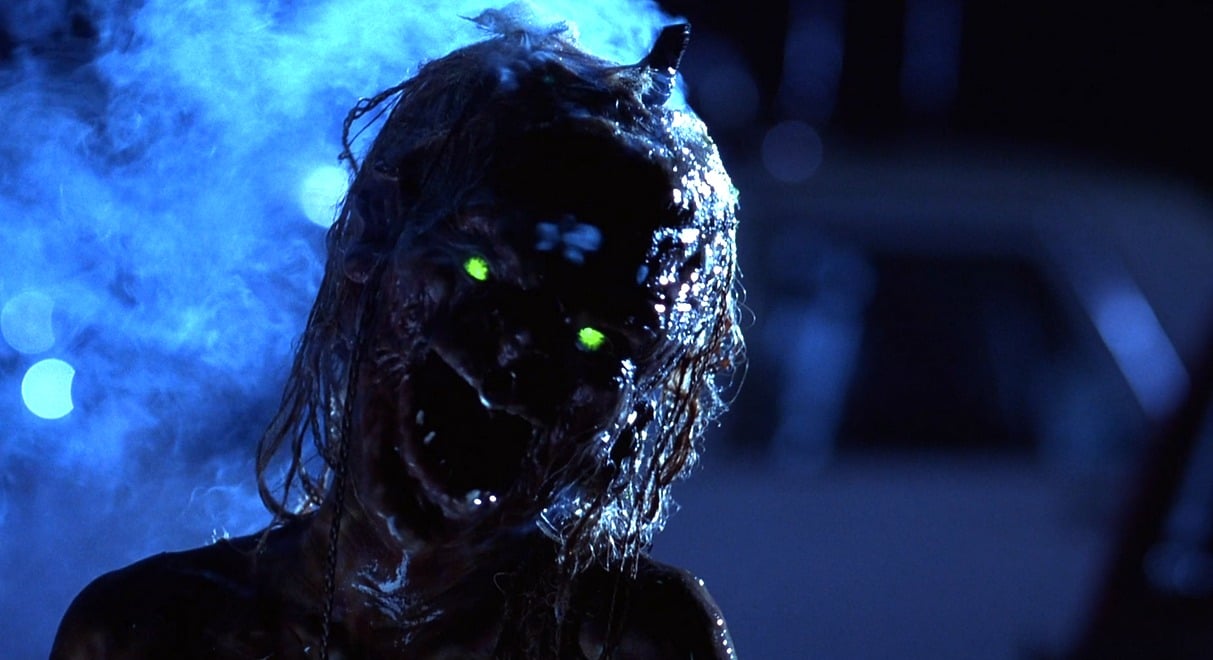
The great Ernest Dickerson turns seventy-five years old this month, so we’re looking back at his most memorable contribution to the horror genre – 1995’s Tales from the Crypt: Demon Knight!
The film hit screens while the Tales from the Crypt series was winding down its run on television, and it stands apart with a story that feels a step or two removed from the franchise norm. That was the smart play, though, as the show’s stories – and those from the original EC comics – work best in short bites. The result is a film that holds up beautifully as a gory good time.
Now keep reading to see what I heard on the commentary for…
Tales from the Crypt: Demon Knight (1995)
Commentator: Ernest Dickerson (director), Michael Felsher (moderator)

1. Dickerson was in post-production on Surviving the Game when he got a call from his agent saying that producer Gil Adler wanted to meet about a Tales from the Crypt feature film. It went well, so Dickerson met with Joel Silver next and secured the job.
2. The original screenplay for the film came to the producers as a spec script wholly detached from the Tales from the Crypt brand. They added the Crypt Keeper (voiced by John Kassir) bookends to make it fit.
3. Dickerson was more familiar with the original EC comic books having read them as a kid, but he had watched a few episodes of the HBO series, so he knew what the current vibe was for the project.
4. Adler directed the film’s wraparound segments, meaning Dickerson never actually got to work with the creepy puppet. “Gil and the Crypt Keeper had a great relationship,” he adds, “they worked together for years.”
5. While he was new to the Tales from the Crypt family, Dickerson had previously worked as a director of photography on the Tales from the Darkside anthology series. That show is underappreciated in my humble opinion, and I will go to bat for both it and the equally underloved Monsters.
6. A big appeal of the horror genre for Dickerson is the idea of dark mysteries that challenge our imagination. For this film, that came down to the mythology being created between the characters.
7. Five executive producers are listed in the opening credits, but Dickerson says the only two he had dealings with were Silver and Richard Donner. The other three were Walter Hill, Robert Zemeckis, and David Giler.
8. Dickerson had only ever seen Billy Zane in movies with a full head of hair, so he was surprised when Zane showed up on the first day with a bald head. “He had this case, and he opened up the case that he had all these hair pieces in, and he says, ‘So which one of these do you think I should use?’” Dickerson looked at him and suggested he just go bald for the character.
9. While the bulk of the opening exteriors were filmed in a desert just outside Los Angeles, the shot of the old church at 11:26 was created on a warehouse hangar soundstage where the film’s interiors were shot.
10. When he had read the script, Dickerson pictured the character of Jeryline (Jada Pinkett Smith) “as a little, tough lady.” He had recently seen Smith in Menace II Society, and while the producers had someone else in mind for the role, he fought to get her instead.
11. Just as Zane surprised Dickerson with his hair (or lack thereof), Smith arrived on the first day with her hair dyed platinum white. He “liked the idea” but asked her to please get it tweaked so it looked more yellowish blond. “It’s definitely a statement.”
12. He had seen Brenda Bakke in the 1989 sci-fi/action film from Japan, Gunhed, and thought she’d be great here as Cordelia. The rest of us might recognize her from Death Spa or Trucks.
13. Felsher comments that the film’s setup does a good job not telegraphing who’s going to live or die, and he uses the “nice guy” (Charles Fleischer) and “the kid” (Ryan O’Donohue) as examples. “You don’t play by those rules here,” he says, and Dickerson replies that he wanted to subvert those rules. That extends to Smith as well because she’s Black, “and usually in movies like this they’re the first folks to die.”
14. Dickerson says they had forty days of filming, “which, the way I’m used to working, was a very generous schedule.” It was budgeted at around $10 million.
15. This probably won’t surprise you, but Zane improvised the bit at 26:25 after he jumps out the window and says, “Fuck this cowboy shit! You fuckin’, hodunk Podunk, well, then, motherfuckers!”
16. In the original script, the demons that The Collector (Zane) raises from the dirt actually looked more like the people they used to be. “They were more human,” but the very smart decision was made in pre-production to make them look far more unique instead.
17. The demons are killed by shooting their eyes, but Dickerson felt there should be one more element to it. “Shoot out their eyes, you gotta duck because the souls come shooting out, and if it hits ya, boom, it can kill ya.” This is a fun touch.
18. He’s been asked more than once if these demons are where Peter Jackson got the idea for how the orcs would look in his Lord of the Rings movies. “They do look like orcs.”
19. He recalls having seen Ronny Yu’s The Bride with White Hair shortly before going to work on Demon Knight, and he hoped to bring some of that staged style into his own film. An example of that in practice is Brayker’s (William Sadler) brief flashbacks to Christ on the cross.
20. Character deaths were mostly based on the idea that “each person’s downfall was going to be predicated by their weakness.” The Collector discovers someone’s weakness and then uses it against them. Cordelia wants to be loved, Jeryline wants to travel, Uncle Willy (Dick Miller) is a horndog for both liquor and ladies, Danny loves horror comics, etc.
21. Dickerson says that plenty of genre classics were in the back of his head while making the film, including Assault on Precinct 13, Alien, Aliens, and more.
22. Cordelia is possessed into a demonic form, and Dickerson’s idea for how she’d look was originally a bit different. “Since Cordelia was a prostitute, I thought that her mouth should actually be a vertical slit that was in her stomach… which would open up with teeth and a tongue.” It was nixed, he says, when “the wife of one of the producers read that and said ‘no way you’re putting that in the movie.’”
23. The key makes an appearance in the followup, Tales from the Crypt: Bordello of Blood, but it wasn’t originally meant to. Apparently, early test audiences expected it to be a more connected sequel to Demon Knight, so the filmmakers added it in to appease them. This is where I go on record saying that Bordello of Blood is a fun time. Can’t touch Demon Knight, obviously, but it’s more entertaining than its reputation suggests.
24. They had to film Uncle Willy’s bar scene “dream” twice, once with the women topless and once with them in bikinis, to have versions for both theaters and television broadcast. “Dick’s a pro.” (To be fair, Dickerson says this in regard to Miller having to endure the makeup application, but the sentiment fits both situations, so…)
25. Dickerson says he’s “always amazed at the love that people show this film,” and adds that fans bring it up to him incredibly often. This is great to hear, as we should always be telling artists how much their work means to us while they’re still alive and able to hear it.
26. Zane also suggested the gag at 1:08:21 with the sponge coming out of his mouth. The beat reminds Dickerson to praise the actor even more, adding that he was an “ally” to the director when “bad ideas” came down from the studio suits.
27. He didn’t get any pushback on killing little Danny. He did insist on one added element, though, as he wanted to immediately follow the boy exploding in the air with a shot of his bloody and torn sneaker hitting the ground below. “And the sneaker had to be a hightop.”
28. Dickerson says there’s “something kinky sexy about” Smith being covered in blood, and then the two commentators go quiet for almost two minutes out of respect for the scene. It’s a good opportunity to reflect on how Dickerson had previously mentioned Alien and Aliens as films being in the back of his head during filming, and how two scenes here reflect that – Jeryline stripping down to her underwear for the final confrontation feels like a nod to Ridley Scott’s film, while an earlier scene with Irene (CCH Pounder) and Dep. Bob (Gary Farmer) realizing they’re surrounded and choosing to blow themselves up alongside some of the demons is something of a callback to the air vent sacrifice in James Cameron’s film.
29. Asked about the film’s critical reception at the time of release, Dickerson says it received good reviews from horror-loving critics and then talks about the importance of horror in general. “Horror has always been a great way of putting out ideas, of talking about some of the things that affect us as people. Some of the best horror, like the best science fiction, talks about what it’s like to be human. Some of the best horror gets very political.”
30. The original ending would have featured The Collector showing “his true self, which is a demon made of fire.” They spent a lot of time trying to make it work, but it was “extremely difficult… back in the day of analog effects.” It was rewritten into the faceoff between him and Jeryline featuring the dancing, the crotch fire, Zane’s attempts at saying “love,” and his eventual demise from her bloody spit.
31. They both agree that a direct sequel to Demon Knight could be a lot of fun, but Dickerson says he’s unaware of any talk on the possibility.
32. Dickerson was super excited about this new Scream Factory Blu-ray in 2015, and he mentions that before its release, he had imported a Blu-ray from Germany presumably to enjoy the film in HD. He’s just like us! (Or am I the only one here who’s imported a German Blu-ray of the much maligned werewolf flick Big Bad Wolf…)
Quotes Without Context

“I was so happy to get Dick Miller for this movie.”
“There was a time when guys used to put ketchup on everything.”
“I’m a big student of Hitchcock, and the best way to make a moment of horror work is to lull the audience into a false sense of security.”
“A villain should always be the most interesting person in a movie.”
“They were a really great bunch of performers who were performing on these little leg-extension stilts wearing a diaper that had a radio-controlled tail that was being manipulated by a special effects tech right out of the frame.”
“It’s hard to direct air; it doesn’t do what you want.”
“The only censorship problem came from the producer’s wife, who didn’t want the vagina dentalis [sic] in the movie.”
“One of the executives wanted to know why the devil didn’t try to have sex with Jada.”
“It always starts with the script.”
Keep up with more horror commentary breakdowns here.
You must be logged in to post a comment.