
Editorials
The End Has Come: Standing Alone as ‘The Last Man on Earth’


Like Invasion of the Body Snatchers, I Am Legend is among the most enduring, flexible, and durable stories in all of horror. It continues to be remade in both official and unofficial capacities with each generation giving Richard Matheson’s seminal novella its own unique twist suited to its current fears. The first, and to date most faithful, adaptation of I Am Legend is The Last Man on Earth (1964) starring Vincent Price in the central role of Robert Morgan. Ironically, this adaptation was disowned by its original creator for several reasons and, though it is the oldest filmed version of the story, perhaps rings truest to us today over sixty years after its making.
Richard Matheson was first hired by England’s Hammer Studios to write a screenplay based on his novella. Unfortunately, the script he turned in was blocked by the British censors who, Hammer believed, were keeping an extra strict eye on them after the release of their gory (for the time) but also highly successful film The Curse of Frankenstein (1957). Hammer would recycle the title of that screenplay, Night Creatures, and place it on a very different film some years later, but the screenplay itself was acquired by American independent producers Robert L. Lippert and Harold E. Knox. The script was also extensively rewritten by William F. Leicester who streamlined the story and made several changes to the dialogue. As a result, Matheson petitioned the Writers Guild to have his name removed from the film. They responded that he would not receive any residuals for the film if he did that, so instead he created the pseudonym Logan Swanson.
The changes in the screenplay were not the only objections Matheson expressed. He was also opposed to the casting of Vincent Price as the lead character, whose name change from Robert Neville was not the only difference from I Am Legend and Night Creatures. Price was, with only a few exceptions in the 40s and early 50s, a rather recently minted horror icon in the early 60s when The Last Man on Earth began filming. Most of his career had been spent in dramas, westerns, and noir films with occasional forays into horror like The Invisible Man Returns (1940) and House of Wax (1953). This all changed in the late 50s after he was “greylisted” by HUAC and found it increasingly difficult to find studio work. This was not a problem, however, for independent renegades like William Castle and James H. Nicholson, Samuel Z. Arkoff, and Roger Corman at American International Pictures who recognized his worth as a star—and his willingness to work for what they could pay. Though Matheson had seen Price cast in films he wrote before, he felt he was more suited to play buttoned-up, erudite types and, more importantly, too old for The Last Man on Earth. But the producers saw the success of films like The Fly (1958), The House on Haunted Hill (1959), and The Fall of the House of Usher (1960) and knew they had their star.
Though the novel and the other official adaptations take place in Los Angeles, The Last Man on Earth was shot in Rome under the direction of Sidney Salkow, who worked primarily with Price, and Ubaldo Ragona who is believed to have been more the technical director, working with the Italian crew. The result is a kind of otherworldliness caused by the disconnect between the “anywhere America” setting implied by the script against the stark, sunbaked visuals of the Roman outskirts. This ultimately works to the benefit of the film giving it an extra dimension of distance from the Americans that would make up its primary audience.

The central conceit of I Am Legend came to Matheson when thinking about Bram Stoker’s Dracula. Count Dracula is one vampire in a world full of humans, but what if that was reversed and there was one human remaining in a world full of vampires? Morgan is a kind of self-styled Van Helsing in this world but also completely out of his depth. When we join him at the opening of the film, three years have passed since a disease that turned humans into vampires swept the world. We see his routine: wake up at sunrise, make sure there is gas in the generator, make some wooden stakes on a lathe, put any bodies laying around in the car and drive them to “the pit” to be burned, kill any vampires he finds, collect supplies like fresh garlic and mirrors. There are no longer any pleasures in life, only canned food, endless routine, and boredom. When he sees his deceased daughter’s doll and the urge for anger rises, he tells himself, “I can’t afford the luxury of anger. Anger can make me vulnerable. It can destroy my reason, and reason is the only advantage I have over them.” Soon we see what a danger emotion can be.
In one of the film’s most powerful and ultimately frightening sequences, Morgan goes to a crypt to visit his wife, Virginia, who is sealed in a marble coffin. He falls asleep in the crypt and wakes after sunset where he is met by a horde of rather pathetic-looking vampires but manages make his escape. When he returns home, he finds another horde knocking at his doors and walls with rudimentary clubs. This is the same horde that comes night after night and is made up of former neighbors and friends including a young man named Ben Cortman (Giacomo Rossi Stuart) who cries out each night for Morgan to come out. When the film flashes back to three years earlier, we also learn that Ben was one of Morgan’s best friends and co-workers. A man that he describes as being like a little brother to him. The man Morgan once protected and mentored now wants nothing more than to drink his blood and tear him limb from limb. But then, Morgan now wants nothing more than to drive a stake through his heart and burn his corpse in the pit on the edge of town.

The flashback sequence has become particularly poignant in the last few years as we continue to heal from our collective trauma of the COVID-19 years. Because of this, the film ultimately rings truer now than it ever has in the 60 years since it was first released. Modern viewers may well recognize friends and family in the characters depicted on screen as the various factions that have arisen in recent years. Morgan is a scientist, a man of pragmatism who wishes to follow the facts and only the facts. “I’m a scientist, not an alarmist,” he tells his wife Virginia (Emma Danieli) and Ben as he shows him a newspaper clipping that postulates that the disease that has spread across Europe may be passed by the winds, indicating that it will be in America soon. Ben Cortman works alongside Robert Morgan but is much more quick to embrace the alarmist rumors that are being spread around the world. In the current day, Ben would be a conspiracy theorist, an anti-vaxxer, or at least someone sympathetic to them.
The scientific explanations for vampirism are perhaps dated but also bring a dimension of realism to the ideas of the film. But then vampirism is really a metaphor for something far deeper and more frightening: conformity. Robert Morgan is surrounded by creatures that look human but are monsters, and they want to make him just like them: mindless, pathetic automatons who feed on the weak and drain any traces of humanity they can. In the last section of the film, Morgan meets Ruth Collins (Franca Bettoia) who is part of a New Order that has learned to temporarily vaccinate the disease but also see Morgan as a threat. They fear him because he destroys vampires and burns bodies. In their society he is a monster. He is legend, as the original title suggests. But he is also able to cure Ruth by giving her a blood transfusion, the antibodies in his blood destroying the virus. The New Order still attack him however because, as Ruth puts it, “the beginning of a new society is never charming or gentle.” Because they are blinded by their own conformity and afraid of Morgan because he is different, they would rather destroy him than admit they are wrong. And because of this, they ultimately destroy the only one who could save them all.

The vampires in both the novel and this film are very different from the powerful superbeings seen in most films. Instead, they are starving, weak, mindless, walking and talking corpses, much more what we think of as zombies in our post-Night of the Living Dead (1968) world. And this is perhaps the greatest influence of both I Am Legend and The Last Man on Earth. George Romero acknowledged that elements of Night of the Living Dead were inspired by Matheson’s novel, though it is unknown if he, co-writer John A. Russo, or anyone else connected with the film had seen The Last Man on Earth, but it is certainly plausible. Watching both films today the similarities are unmistakable though Night ultimately far exceeds Last Man in quality and impact on the future of horror. After the release of The Omega Man (1971), the second official film version of I Am Legend starring Charlton Heston, Matheson was asked what the best adaptation of his novel was and he immediately replied, Night of the Living Dead. Of course, we still feel the reverberations of Romero’s zombies to this day in the hordes of zombie variations from The Walking Dead, to World War Z (the novel and film), to 28 Days Later. The latest version of I Am Legend from 2007 starring Will Smith closes the circle and simply transforms Matheson’s vampires into zombies.
Still, despite its flaws (the dubbing certainly leaves something to be desired), The Last Man on Earth remains a striking film and feels even more relevant today than it did in 1964. In today’s world it can feel practically impossible to stand strong against the crowds that chide us to become “one of them.” This world can wear us down through the constant barrage of disinformation, conspiracy theories, and outright lies that flood our senses practically every minute of every day. We are surrounded by a rising tide that calls for us to fall in line or face the consequences. The Last Man on Earth is a call for nonconformity in a time of increasing demands for uniformity and a cry for sanity in an insane world.
In Bride of Frankenstein, Dr. Pretorius, played by the inimitable Ernest Thesiger, raises his glass and proposes a toast to Colin Clive’s Henry Frankenstein—“to a new world of Gods and Monsters.” I invite you to join me in exploring this world, focusing on horror films from the dawn of the Universal Monster movies in 1931 to the collapse of the studio system and the rise of the new Hollywood rebels in the late 1960’s. With this period as our focus, and occasional ventures beyond, we will explore this magnificent world of classic horror. So, I raise my glass to you and invite you to join me in the toast.


College kids, strippers and vampires—those were Donald P. Borchers’ only requirements when he approached Richard Wenk about writing and directing a movie for New World Pictures. As requested, Wenk cooked up Vamp (1986), a tailor-made blend of the decade’s teen movie craze as well as its horror boom.
Grim and earnest stories were still very much a part of the ’80s horror landscape, yet Vamp is something of a comedy. One difference between it and, say, Saturday the 14th, though, is the former avoids using schtick. Wenk’s movie proves that horror comedies also don’t have to subtract thrills from their recipes. Of course, it takes a minute before reaching that point; college antics and culture shocks preface this one macabre misadventure.
Vamp‘s initial setup is apt for a typical college-set, sex-driven comedy; to bribe their way into a fraternity house, two pledges (Chris Makepeace, Robert Rusler) go looking for some adult entertainment. Without wasting time on any further exposition, the characters embark on an all-in-one-night trip that quickly detours into terror.
To procure their elusive MacGuffin—a stripper willing to gyrate for some frat boys—Keith (Makepeace) and AJ (Rusler), plus a third wheel named Duncan (Gedee Watanabe), trade the safety of their remote college campus for the seediness of some unnamed city. The setting is recognizably L.A. by day, but as soon as night falls, downtown, along with the characters, slips into a kind of surreal universe. Director of photography Elliot Davis gave this early entry on his prolific résumé an unusual yet distinctive look; that Mario Bava-esque, magenta-green lighting is omnipresent, so much so that it’s almost its own character.

Chris Makepeace and Robert Rusler in Vamp
The faint comparisons to Martin Scorsese’s After Hours are merited, although not just because of Vamp’s distinguishing nighttime aesthetic. Save for the primary characters, the supporting roles in Wenk’s movie are also quite colorful and transactional in their behavior. The difference here, though, is the additional urge to ruin Keith and his friends at every turn. Some of that harm is humorous and tolerable enough, whereas the moment Vamp dishes out its first fatality, it’s abundantly clear how this movie qualifies as horror.
Vamp falls into that category of horror movie that reveals its genre with a scream rather than a series of whispers. The opening scene can function as a hint of what lies ahead—things are not at all what they appear to be—but otherwise, Wenk is more than happy to hold off on the horror. When that time does come, though, it catches the viewer off guard. In addition to the pure shock value is that sudden decision to upend the movie’s foremost feature. Or so it would seem.
If afraid of major spoilage, those new to Vamp would be wise to stop reading here. There’s just no skirting around the fact that the central fellowship in this buddy movie hits a serious snag when AJ is killed. That development causes the story to become more of a “long, bad night” journey for Keith and his romantic interest. So while Wenk scores points for subverting expectations, there is also a touch of sadness in his decision. Because if Vamp does anything well, it’s making the characters likable.
Something that comes easily to Vamp—and other teen horror movies from this same era—is its ability to invent young characters worth caring about, or at the very least, are interesting and not so immediately off-putting. More impressive is how Wenk did all this without actually fleshing out those characters. Still and all, Keith and his kind are a grade above cookie-cutter, and in some cases, aren’t completely devoid of growth.

Grace Jones in Vamp
Vamp appeals with an assorted cast of characters. No two are the same, nor are they operating on the same wavelength. The cinematically extroverted AJ, whose actor conveyed charm and vulnerability in near equal amounts, comes alive when he’s at his most undead. Makepeace then makes the chronically cautious Keith a sympathetic fellow, even as he’s more and more affected by the night’s bizarre events. Meanwhile, Duncan is indeed the designated loser of the whole bunch, but Watanabe still manages to humanize him. As a bonus, the role didn’t require him to pull a Long Duk Dong.
As for Dedee Pfeiffer, she is plain adorable as the mysterious After Dark server nicknamed “Amaretto”. She spends all night fixing her dress strap while at the same time trying to get Keith to remember how he knows her. As their offbeat romance grows, it becomes another highlight of this movie. Whether or not Pfeiffer’s character is really a vampire also creates some welcome tension in the story.
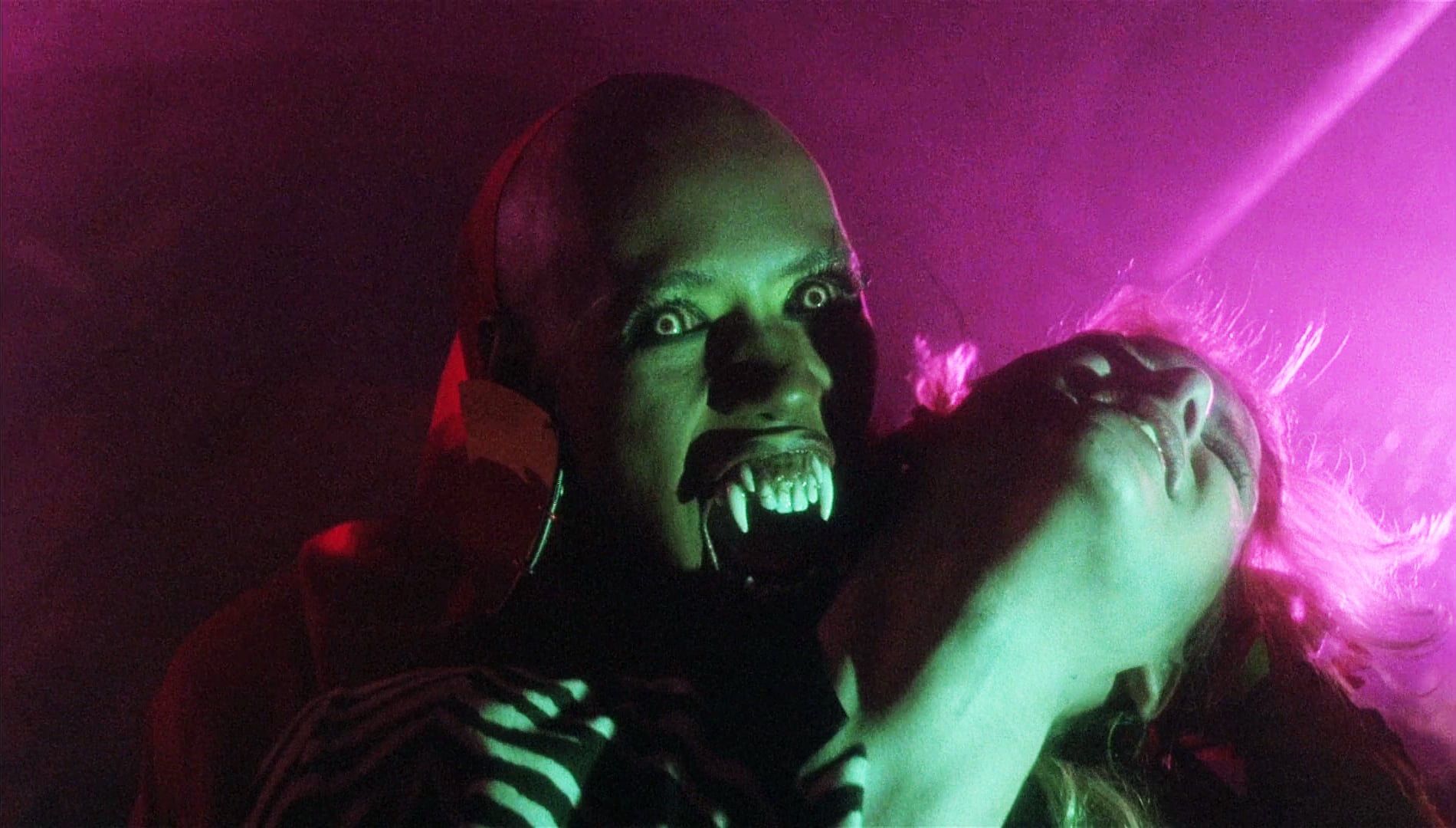
Like a lot of its contemporaries, Vamp went on to become a bit of a cult classic. That current status is determined by several factors, but without a doubt, the casting of Grace Jones is the most considerable. The image of her writhing on that unique-looking chair, a Keith Haring original, springs to mind whenever this movie is brought up.

Chris Makepeace, Billy Drago and Paunita Nichols in Vamp
Prior to that first display of unequivocal horror, local vampire queen Katrina (Jones) took to the stage and delivered a strip show like no other. One would expect nothing less from that renowned model and performance artist. By now reports of Jones’ tardiness on set are no secret, yet it’s also hard to deny her commitment to the part of Katrina. It was, in fact, Jones who took charge of her character’s appearance—on top of Haring painting her body and that now-iconic chair, she had Andy Warhol handle her costuming. And not too many actors could seize a room’s attention without saying a single line of dialogue.
In 2022, Vamp received a retrospective novelization from Encyclopocalypse. This literary union of preexisting source material—Wenk’s original screenplay—and new ideas from author Christian Francis amounts to a more comprehensive visit to the After Dark Club. The basic story there is no different than what’s shown on screen; however, Francis gets creative with the characters’ origins and designs, and he enhances a number of key scenes.
The novelization expands on the urban and social decay of the main setting, and supplies a background for the After Dark Club. Sandy Baron’s character, Katrina’s emcee and familiar, is given ample motivation for sticking around; up until the fiery end, he is loyal to his friend and former business partner “Squeak”, who looks like he was “fed through a combine harvester, and left as nothing more than a heap of mangled remains”. Then there is Billy Drago’s character Snow, the leader of a street gang called The Dragons. His reason for menacing Keith and AJ is more altruistic than in the movie; he and his peers act tough to scare off any potential food for the vampires.

Lisa Lyon in Vamp
If not for all the backstories, Francis’ Vamp would be a hell of a lot shorter. Instead, this tie-in read dives into how AJ met Keith—the orphaned Anthony Joseph hailed from a broken home back in Brooklyn—and how their friendship flourished over the years. Keith’s archership is no longer just an assumed part of his entire being; it’s a confidence-building extracurricular for a boy who got picked on before coming into the protection of the new kid in town. These supplemental, in-depth looks at the protagonists, plus their close connection, are maybe unnecessary. The movie already did a fair and concise job of addressing their platonic intimacy without the need for flashbacks and insights, specifically in that scene where AJ lays it all out as he sacrifices himself.
Where the novelization gets off course is its approach to the minor characters. Intermittently backstorying the likes of Katrina’s indentured servants, Seko (Leila Hee Olsen) and Vlad (Brad Logan), ends up disturbing the flow of the writing. Was it absolutely essential that readers know Vlad was the Grand Duke of the House of Romanov, or how Snow’s accomplice Maven (Paunita Nichols) became so dentally challenged? No, not really. However, one’s mileage with these random biographies may vary.
The novelization is a more substantial experience, but for a movie like Vamp, less is more. And as plentiful as they are, it never simply coasts on its campy charms, either. The character work sits comfortably in that realm between cursory and meticulous, the script is sharper than first realized, and Greg Cannom’s vampire makeup is straightforward yet effective. Most of all, the movie didn’t squander its out-of-the-box concept. Richard Wenk made his vision of a “comic nightmare in which just about anything that can go wrong does” come true, and it is very enjoyable.

You must be logged in to post a comment.