Editorials
‘Flesh for Frankenstein’ – The Good Doctor Gets Naughty in This Must-See Exploitation Adaptation

Oh boy. This movie.
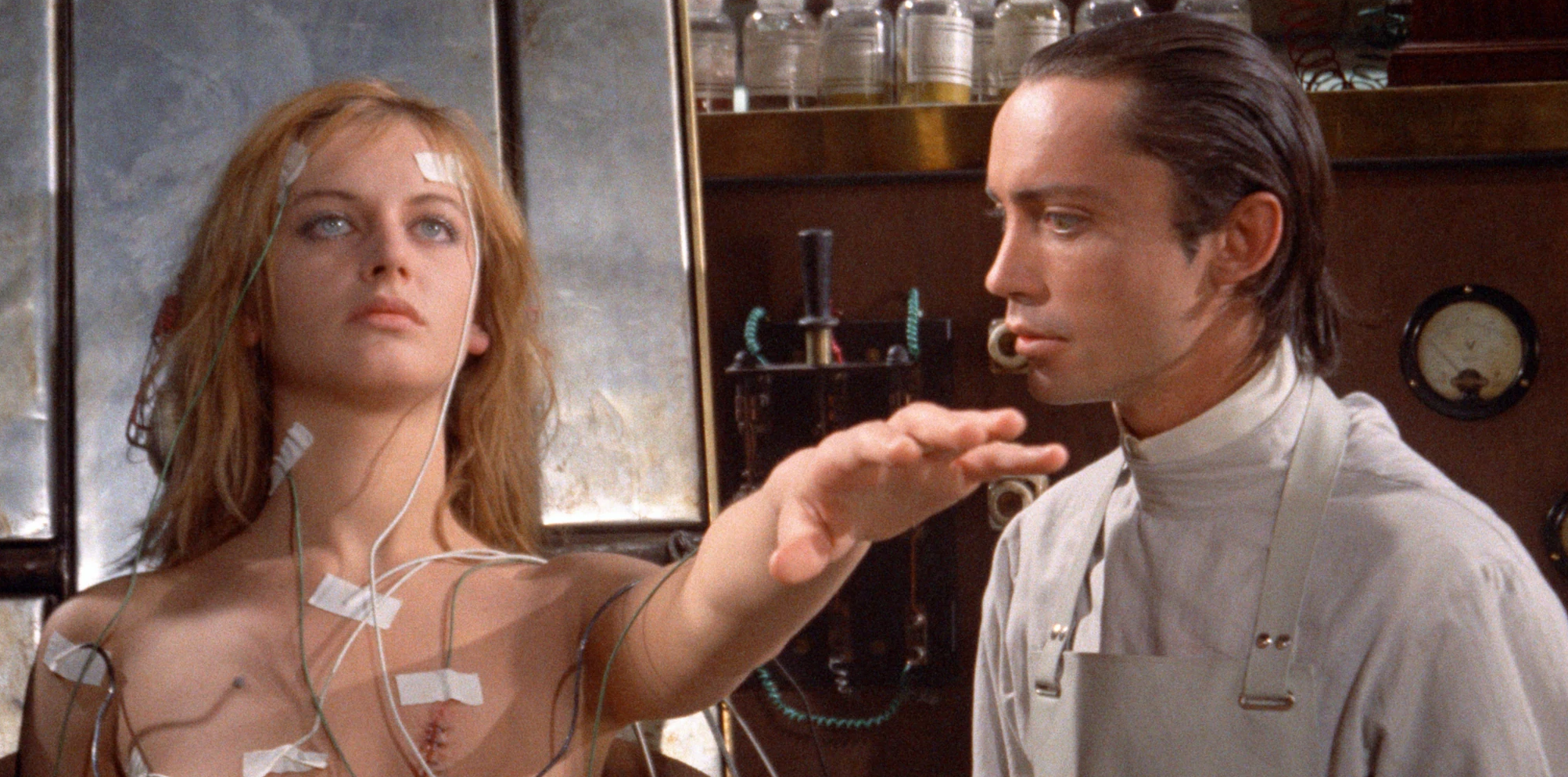
Paul Morrisey’s 1973 feature Flesh for Frankenstein (AKA Andy Warhol’s Frankenstein) is quite the dip into genre absurdity. Initially the film may look like a more sexed up Hammer production, but it quickly establishes itself as something far more perverse and darkly comedic than any of Hammer’s stately, gothic curios.
The plot is standard Frankenstein fare, just with a nice dollop of exploitation sleaze thrown into the mix. Played by indomitable international icon Udo Kier, Baron Frankenstein is an openly fascistic figure who is determined to create two perfect “zombies” from pillaged human remains. Once these zombies are complete, he plans to have them mate to create the perfect master race that will obey his every command.
Little does the Baron know that all is not well in the house of Frankenstein, as sexual deviancy and twisted desires work to undermine his grand designs.
Flesh for Frankenstein is campy with a capital C. The dialogue is exceedingly silly and the delivery from the cast is more than a little hysterical throughout.
Considering the film’s tone however, this Grand Guignol of near-farcical proportions feels largely intentional. Morrisey is keen to have you squirm as much as possible and giggle at the absurdity being displayed – sometimes both at once.

The sexuality in Flesh for Frankenstein is the driving theme. Phallic and yonic imagery abound in the film – one particular visual gag during the climax involving a wooden pike and an internal organ is so loaded with meaning I genuinely laughed out loud.
The good doctor is married to his own sister Katrin (Monique van Voreen) in a loveless relationship that bore them two children. Neither party are particularly interested in fulfilling their carnal desires with each other and seek it through other means – all the while casting damnation and judgment on everybody else’s sexual choices. Katrin lords her status about the castle, chastising hired hands for their sexual proclivities all the while indulging in her own under the nose of her husband-brother.
Frankenstein isn’t just interested in building his master race, he is also interested in screwing it. Literally. “To know death, Otto – you have to f**k life! In the gallbladder!”
For 1973, the sexual acts depicted in the film are enough to give you the vapors if you weren’t prepared beforehand.

While hardly the most explicit or shocking genre film to deal with the themes of death and sex, Flesh for Frankenstein still packs enough queasy perversity to make you uneasy.
Underneath the nudity, overacting, and vibrant splashes of gore – just what is Flesh for Frankenstein about?
Paul Morrisey hailed from Warhol’s Factory, so it’s safe to assume the social satire present in this film is no fluke. The narrative plays as one big piss take on the hypocrisy and moral decay of the wealthy elite.
Throughout the film both the Baron and Katrin are seen exploiting and manipulating the working class for their own gain. The two quite literally see these people as nothing but flesh to do with as they will. The Baron is convinced of his own ethnic and intellectual superiority and feels it is his innate right to conquer and rule. Morrisey takes the principle Frankenstein conceit Mary Shelley introduced in her seminal novel and stretches it to its extreme conclusion with all the trimmings lovers of exploitation cinema groove to.
If you haven’t seen Flesh for Frankenstein, do yourself a favor and seek it out. It’s full to bursting with camp entertainment, delightful gore gags, and enough satirical merit make it stand severed heads and maimed torsos above many other Frankenstein adaptations.
You can grab Flesh for Frankenstein in 4K Ultra HD from Vinegar Syndrome.


Found footage movies rely on immersion and a particular kind of suspension of disbelief in order to scare viewers, so it stands to reason that playing along with the “kayfabe” of it all is necessary for these movies to be effective. However, despite being something of a purist when it comes to in-universe recordings, I’ve come to accept that traditional productions can benefit from the occasional injection of found footage thrills.
For instance, Kane Parsons’ Backrooms adaptation makes genius use of the analog gimmick in order to trap us in the titular rooms alongside our main characters before effortlessly switching back to a more cinematic language. In honor of these dynamic films that manage to combine the best of both worlds, today I’d like to share six other hybrid horror movies that successfully incorporate found footage into their scares!
For the purposes of this list, “hybrid” horror movies are defined as any flick that shifts between diegetic recordings and traditional filming techniques for a significant amount of time (or at least for pivotal scenes).
As usual, don’t forget to comment below with your own hybrid favorites if you think a particularly freaky one was missed.
With that out of the way, onto the list!
5. The Last Broadcast (1998)

Internet critics may have overstated the influence that Stefan Avalos and Lance Weiler’s The Last Broadcast had on The Blair Witch Project, but the found footage subgenre still owes a huge debt to this underrated piece of avant-garde filmmaking. However, while the movie sets itself up as a documentary about the disappearance of a group of cryptid-hunters attempting to track down the Jersey Devil, things take a darker and much more grounded turn towards the final act.
I won’t get into details in order to avoid spoilers, but suffice to say that the jarring shift in perspective actually helps to sell the idea that everything we’ve seen before the finale was an attempt at using filmmaking to manipulate the public perception of a “real” incident.
Not bad for a movie with a $900 budget!
4. Cam (2018)

When you consider just how much the internet affects our daily lives, it’s strange that we don’t see Screenlife elements pop up in more movies these days. For instance, Isa Mazzei & Daniel Goldhaber’s highly underrated Cam only works as a freaky parable about online sex-work because it masterfully balances Madeline Brewer’s intimate moments with highly immersive segments within cyberspace.
While one might argue that the entire film could have been produced as a Screenlife experience, the hybrid approach allows the filmmakers to explore our main character’s life beyond the screens – with the duality of modern human existence actually becoming a recurring theme in the story.
3. Banshee Chapter (2013)

Most of H.P. Lovecraft’s popular stories were told in the epistolary format (where the text is presented as an in-universe compilation of letters or personal notes), so it makes sense that a spiritually faithful adaptation of his work would incorporate elements from the modern-day equivalent to epistolary fiction – found footage!
That’s why Blair Erickson’s Banshee Chapter is such an effective scare-fest, as this hybrid adaptation of From Beyond -retold through a conspiratorial lens as it references MK-Ultra and even secretive numbers stations- immerses viewers in a mind-bending tapestry of Cosmic Horror that blurs the line between fiction and reality.
2. The Deep House (2019)

The underwater setting does a lot of the heavy lifting when it comes to Alexandre Bustillo and Julien Maury’s The Deep House, with the film being especially uncomfortable if you’re already scared of tight spaces and being deprived of oxygen. However, even the universally unsettling elements of the flick only work because the POV often shifts into claustrophobic footage courtesy of our main characters’ GoPro cameras.
Telling the story of a couple of YouTubers who encounter a haunted house at the bottom of an artificial lake while vacationing in France, The Deep House’s first-person exploration sequences contain some of the film’s scariest moments. In fact, I’d argue that the movie didn’t even need ghosts, as becoming trapped in the titular House already sounds like a fate worse than death.
1. Behind The Mask: The Rise of Leslie Vernon (2006)

My personal favorite instance of filmmakers successfully managing to combine traditional cinematography with POV filmmaking, Behind the Mask: The Rise of Leslie Vernon, is proof that the two formats can co-exist if the right story comes along.
After all, what better way to conclude a mockumentary all about reality getting increasingly more cinematic than by ditching the found footage gimmick altogether during the finale? Not only does this shift in presentation work on a conceptual level, but it also elevates Behind The Mask into a proper Slasher, which is probably why we’re so excited for that long-overdue sequel!
You must be logged in to post a comment.