Editorials
‘Pitch Black’ 22 Years Later – The Kind of Big Screen Monster Movie We Need More of Today

I don’t like to lament the changing tides of the cinematic landscape as so many are wont to do on social media. I like to go with the flow – watch what I want, ignore what doesn’t interest me, and that’s it.
But if there is one thing I genuinely miss, it’s the period where decently budgeted, high concept creature-features could be made and given wide theatrical releases. And they were mainstream!
Every once in a while one may slip through the cracks (Alexandre Aja’s Crawl and the 47 Meters Down films being recent examples) but for the most part this type of theatrical experience is dead.
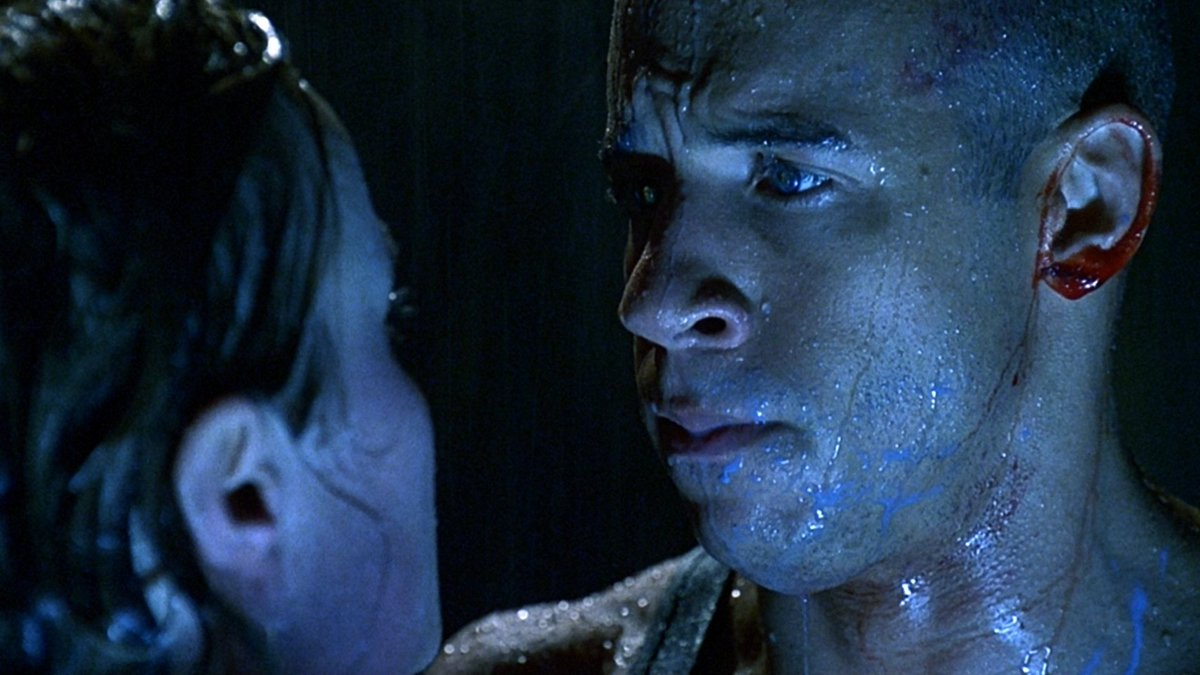
David Twohy’s Pitch Black just recently celebrated its 22nd birthday this year, and I think it’s time to celebrate the unlikely franchise-starter for being a damn good sci-fi/horror film that first introduced the cult favorite anti-hero, Riddick.
By the time Pitch Black dropped David Twohy had already been in the game for quite some time. His first Hollywood writing credit is for Critters 2: The Main Course and from there he went on to write the cult classic Warlock and has credits for everything ranging from The Fugitive to G.I. Jane to Waterworld.
Pitch Black was his third time in the director’s chair after helming Timescape and The Arrival. Working from an initial script given over for him to tinker with, Twohy rewrote the film to amp it up into its own beast. There is a distinctive hard-edge, no-nonsense quality to Pitch Black that makes it very appealing. There is a dose of John Carpenter-esque cynicism to the story and characters here that feel right at home alongside films like Escape from New York and The Thing.

A transport vessel cruising the backwaters of the space lanes is struck by a rogue asteroid, causing it to crash on a desolate planet scorching under perpetual daylight. The ship was transporting dozens of individuals in cryosleep – everything from holy men on a pilgrimage to one hell of a dangerous convict by the name of Richard B. Riddick – Vin Diesel’s breakout, and in my opinion, best role.
In their struggle to figure out a way off the planet, the survivors soon find out that they arrived just in time for the planet’s nightfall 22 years in the making—and with the darkness comes the monsters. Their only hope of getting off the planet relies on the killer they all fear. Riddick can see in the dark. Can a monster save them from other monsters?
High concept premises like this almost always hinge on the characters, and Twohy manages to craft a handful of them that refreshingly break the mold they initially seem to occupy. Our lead, Fry (Radha Mitchell) is hiding a secret from the rest of the survivors – that she almost jettisoned them into space to save her own ass.
The cop transporting Riddick, Johns (Cole Hauser) turns out not to be a cop at all, but a mercenary with a drug addiction who may not be any better than the murderer he’s captured. Even the young boy, Jack, is hiding something from everyone.
The theme of secrets, of hiding who you really are, is a fun one to explore in a film like this and gives the plot added meat to dig into outside of being a fun monster movie. The planet itself is hiding its own secrets just underneath the surface. As the threat rises and the suns set, the tenuous team of survivors begins to unravel.
The only principle character in the film that seems to be honest about who and what they are is, of course, Riddick. He doesn’t put on any airs about who and what he is. What he does do, is expertly get into the heads of everyone he can for his own benefit.

Riddick is a gloriously fun character. Diesel has become something of meme in recent years, so it’s easy to forget he has his own brand of charisma and energy that can make him perfect for certain roles. Riddick is the type of villain you can’t help but love. He’s charismatic and sly. He’s funny and even charming, but Twohy and Diesel keep him unknowable. You can never pin down exactly what he’s planning or what he’s going to do and that makes him scary. Riddick is truly a free agent, playing his cards just right the entire time to keep his ass from being alien chow.
Every time you think the narrative is carrying the characters a certain way, Twohy yanks the rug out from under you. He gets you to root for characters you previously wanted to see dead, and root against characters you wanted to see redeemed. This level of moral ambiguity is rare in creature features. There are no easily digestible character arcs to feel nice about as the credits roll. When the film ends, you’re left wondering if you’d have done the same as the characters, or if what they did was justified given the situation they were in.
Pitch Black is a monster movie, right? All I’ve done is babble about the characters. Never fear, there are indeed monsters in this monster movie – and they’re awesome.
The creatures go unnamed the entire film. They’re completely nocturnal and burn in the light. They fly, only have two legs, and sport wicked hammerhead shark-like noggins. They’re all angles, claws, and teeth. The creature design here is inspired. These things are unlike most any other monsters you can find in the genre. Every single time I re-watch Pitch Black I can’t help but think to myself, “Damn, these things are cool.”
The film was produced when blockbusters were still on the cusp of mixing and matching effects techniques, so Pitch Black is a fun curio to look back on from an effects standpoint. Real sets, models, props, and locations were used to bring the film to life. Many of these aspects would most assuredly be accomplished digitally today. At the same time, the effects primarily used to bring the creatures to life are computer-generated – and the CGI largely still holds up today despite certain shots showing their age.
I’m not one to cast aspersions to the sky about the demise of practical effects and the abundance of CGI in modern film, but it’s still fun to look back to movies of the recent past and see that the old ways were still being used not that long ago. Then again, I guess in movie years 22 years is a long time ago. I just don’t like to think it is. Any film that was released in my lifetime can’t be old. That means that I’m getting old. And I don’t like that. Not one bit!
Pitch Black plays all of its cards right. It’s got an engaging hook, a good cast, morally grey characters, cool as hell monsters, and handsome filmmaking to boot. Today the film would most likely be released directly to one of the myriad streaming services vying for dominance and that’s totally fine. Streaming has opened the doors up for mid-range films of this nature to actually be made again, but the nostalgic part of me will never let go of the unique experience of seeing a film like Pitch Black on the big screen with an audience. We need more like it today.


Found footage movies rely on immersion and a particular kind of suspension of disbelief in order to scare viewers, so it stands to reason that playing along with the “kayfabe” of it all is necessary for these movies to be effective. However, despite being something of a purist when it comes to in-universe recordings, I’ve come to accept that traditional productions can benefit from the occasional injection of found footage thrills.
For instance, Kane Parsons’ Backrooms adaptation makes genius use of the analog gimmick in order to trap us in the titular rooms alongside our main characters before effortlessly switching back to a more cinematic language. In honor of these dynamic films that manage to combine the best of both worlds, today I’d like to share six other hybrid horror movies that successfully incorporate found footage into their scares!
For the purposes of this list, “hybrid” horror movies are defined as any flick that shifts between diegetic recordings and traditional filming techniques for a significant amount of time (or at least for pivotal scenes).
As usual, don’t forget to comment below with your own hybrid favorites if you think a particularly freaky one was missed.
With that out of the way, onto the list!
5. The Last Broadcast (1998)

Internet critics may have overstated the influence that Stefan Avalos and Lance Weiler’s The Last Broadcast had on The Blair Witch Project, but the found footage subgenre still owes a huge debt to this underrated piece of avant-garde filmmaking. However, while the movie sets itself up as a documentary about the disappearance of a group of cryptid-hunters attempting to track down the Jersey Devil, things take a darker and much more grounded turn towards the final act.
I won’t get into details in order to avoid spoilers, but suffice to say that the jarring shift in perspective actually helps to sell the idea that everything we’ve seen before the finale was an attempt at using filmmaking to manipulate the public perception of a “real” incident.
Not bad for a movie with a $900 budget!
4. Cam (2018)

When you consider just how much the internet affects our daily lives, it’s strange that we don’t see Screenlife elements pop up in more movies these days. For instance, Isa Mazzei & Daniel Goldhaber’s highly underrated Cam only works as a freaky parable about online sex-work because it masterfully balances Madeline Brewer’s intimate moments with highly immersive segments within cyberspace.
While one might argue that the entire film could have been produced as a Screenlife experience, the hybrid approach allows the filmmakers to explore our main character’s life beyond the screens – with the duality of modern human existence actually becoming a recurring theme in the story.
3. Banshee Chapter (2013)

Most of H.P. Lovecraft’s popular stories were told in the epistolary format (where the text is presented as an in-universe compilation of letters or personal notes), so it makes sense that a spiritually faithful adaptation of his work would incorporate elements from the modern-day equivalent to epistolary fiction – found footage!
That’s why Blair Erickson’s Banshee Chapter is such an effective scare-fest, as this hybrid adaptation of From Beyond -retold through a conspiratorial lens as it references MK-Ultra and even secretive numbers stations- immerses viewers in a mind-bending tapestry of Cosmic Horror that blurs the line between fiction and reality.
2. The Deep House (2019)

The underwater setting does a lot of the heavy lifting when it comes to Alexandre Bustillo and Julien Maury’s The Deep House, with the film being especially uncomfortable if you’re already scared of tight spaces and being deprived of oxygen. However, even the universally unsettling elements of the flick only work because the POV often shifts into claustrophobic footage courtesy of our main characters’ GoPro cameras.
Telling the story of a couple of YouTubers who encounter a haunted house at the bottom of an artificial lake while vacationing in France, The Deep House’s first-person exploration sequences contain some of the film’s scariest moments. In fact, I’d argue that the movie didn’t even need ghosts, as becoming trapped in the titular House already sounds like a fate worse than death.
1. Behind The Mask: The Rise of Leslie Vernon (2006)

My personal favorite instance of filmmakers successfully managing to combine traditional cinematography with POV filmmaking, Behind the Mask: The Rise of Leslie Vernon, is proof that the two formats can co-exist if the right story comes along.
After all, what better way to conclude a mockumentary all about reality getting increasingly more cinematic than by ditching the found footage gimmick altogether during the finale? Not only does this shift in presentation work on a conceptual level, but it also elevates Behind The Mask into a proper Slasher, which is probably why we’re so excited for that long-overdue sequel!
You must be logged in to post a comment.