Editorials
“Nightmares & Dreamscapes” – Revisiting TNT’s Stephen King Horror Event Series from 2006

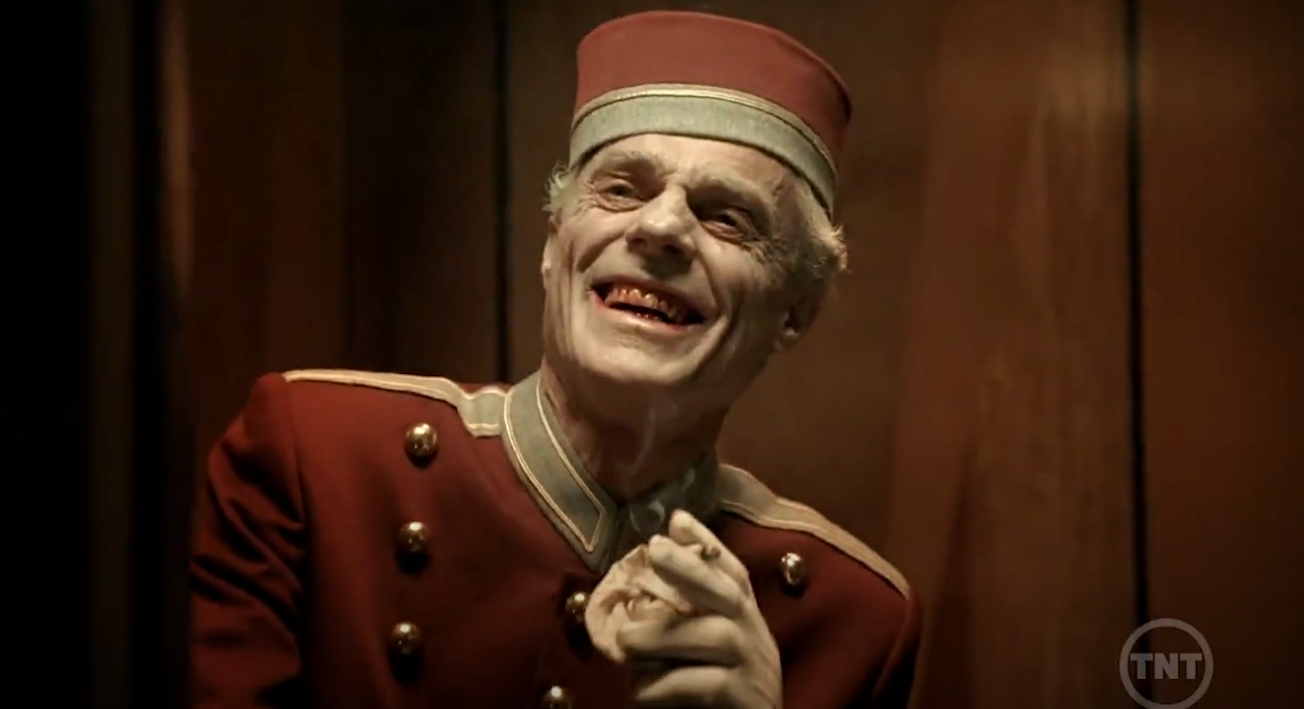
Whether measured by quality, quantity, or any other conceivable metric, Stephen King is virtually unparalleled in the literary world. When it comes to translating his work to the screen, on the other hand, the results are uneven to say the least. With multiple films and TV series based on his writing being produced each year – to the point where his books are optioned before they’re even published – it’s no surprise that some adaptations slip through the cracks.
Following the success of their 2004 Salem’s Lot miniseries, TNT returned to the world of King with Nightmares & Dreamscapes: From the Stories of Stephen King. Filmed in Melbourne, Australia, the eight-episode anthology series aired as a four-week event – two episodes each Wednesday night – in the summer of 2006 before hitting DVD in time for Halloween that year. As with any anthology, the installments are hit or miss, but the unpredictability is part of the fun. Several name actors and notable filmmakers were involved, including some King alumni.
Five of Nightmares & Dreamscapes‘ episodes – “Crouch End,” “Umney’s Last Case,” “The End of the Whole Mess,” “The Fifth Quarter,” and “You Know They Got a Hell of a Band” – are based on stories from King’s 1993 short story collection of the same name, while “Battleground” comes from 1978’s Night Shift and “The Road Virus Heads North” and “Autopsy Room Four” are in 2002’s Everything’s Eventual.
Presented without any dialogue, “Battleground” is an intrepid choice to kick off the series – but it’s also the strongest of the eight episodes. Like a darker take on Small Soldiers, a hitman (William Hurt, A History of Violence) finds himself being attacked by little green army men toys and their weapons of war after killing a renowned toy manufacturer. Hurt’s wordless, solo performance carries the episode, with the ever-present score by Jeff Beal (House of Cards, Monk) helping to shoulder some of the weight.
The special effects are surprisingly strong for a network TV show at the time, but that should come as no surprise upon the realization that it’s directed by Brian Henson (The Muppet Christmas Carol), who harnesses the powers of Jim Henson’s Creature Shop. Writer Richard Christian Matheson (Three O’Clock High) sneaks in a nod to another famous killer toy: the Zuni fetish doll from 1975’s Trilogy of Terror, penned by his father, the great Richard Matheson. The episode earned Emmy awards for Outstanding Music Composition and Outstanding Special Visual Effects.

“Crouch End” is King’s tribute to H.P. Lovecraft, but director Mark Haber (Alien Cargo) and writer Kim LeMasters prove unable to render the cosmic dread on screen. Honeymooning in London, newlyweds Doris (Claire Forlani, Mallrats) and Lonnie (Eion Bailey, Band of Brothers) find themselves lost in Crouch End, a notorious area built on a place of ritual sacrifice that now serves as a portal to another dimension. It’s the only episode that goes full-bore into horror, but it’s a painfully generic genre outing even if you overlook the unflattering aesthetic and cheesy CGI.
One of King’s many stories about authors, “Umney’s Last Case” is a love letter to Raymond Chandler’s pulpy detective stories. It’s about a hard-boiled gumshoe circa 1938 whose world is upended when the author of his life reveals himself. William H. Macy (Fargo) plays both roles, earning himself an Emmy nomination for the dual performance. Director Rob Bowman (Reign of Fire) and writer April Smith embrace the Chandler pastiche, with King’s clever twist on the material subverting the tropes.

In “The End of the Whole Mess,” Howard Fornoy (Ron Livingston, The Conjuring) recounts the unbelievable story of his genius younger brother, Bobby (Henry Thomas, E.T. the Extra-Terrestrial), whose discovery achieves world peace before yielding dire consequences. Director Mikael Salomon (who helmed the aforementioned Salem’s Lot miniseries) successfully builds intrigue and emotion, save for the questionable choice to turn September 11th into a plot catalyst.
Instead of journal entries like in the original story, fearless King adaptor Lawrence D. Cohen (who also tackled Carrie (1976 and 2013), It (1990), and The Tommyknockers) turns Howard into a filmmaker documenting the story. It’s a smart approach for the visual medium, though it’s ultimately underutilized – the copious flashbacks are just that, rather than footage shot by Howard – and the impact of King’s written ending is missed.

“The Road Virus Heads North” is yet another story about a writer. King uses aging horror author Richard Kinnell (Tom Berenger, Platoon) as a conduit for his grievances about life in the spotlight before getting to the meat of the story. After purchasing a menacing painting at a yard sale, Kinnell soon discovers that it changes each time he looks at it, reappears when he tries to destroy it, and kills anyone that gets in its way. Director Sergio Mimica-Gezzan (Battlestar Galactica) and writer Peter Filardi (The Craft, Flatliners) deliver an interesting, if familiar, setup that lacks a satisfying conclusion.
“The Fifth Quarter” plays like one of the many Tarantino-esque crime thrillers produced in the wake of Reservoir Dogs and Pulp Fiction, which isn’t a bad thing. Jeremy Sisto (Wrong Turn) stars as a newly released convict whose dying friend tells him about a map that reveals the location of $3.5 million. Despite a desire to stay straight for his wife (Samantha Mathis, Broken Arrow) and son (Kodi Smit-McPhee, The Road), he goes on a dangerous quest for the money. Bowman directs again, this time from a script by Alan Sharp (Rob Roy), crafting an engaging tale of crime and greed.

Perhaps the most compelling episode of Nightmares & Dreamscapes, “Autopsy Room Four” draws inspiration from Louis Pollock’s 1947 short story “Breakdown.” The plot concerns a man (Richard Thomas, who starred as the adult version of Bill in 1990’s It) who has been pronounced dead but is still conscious as he’s brought into the morgue for his autopsy. Trapped inside his own mind, he’s completely immobile but able to think – and feel. Thomas narrates the character’s inner monologue, piecing together the events leading up to his presumed death. Salomon directs from a script by Smith, embracing a dark sense of humor without sacrificing tension.
“You Know They Got a Hell of a Band” features a classic setup that brings to mind The Twilight Zone (which is name-checked in the episode) and King’s own Children of the Corn. A husband (Steven Weber, who boldly assumed the role of Jack Torrance in 1997’s The Shining miniseries) and wife (Kim Delaney, NYPD Blue) on a road trip find themselves in a seemingly idyllic small town that harbors a secret: it’s inhabited by dead musicians. From Janis Joplin and Elvis Presley to Buddy Holly and Jimi Hendrix, the impersonations are fun, but writer-director Mike Robe (Return to Lonesome Dove) is unable to elevate the ordeal beyond the one-note gimmick.
Each episode of Nightmares & Dreamscapes: From the Stories of Stephen King runs about 45 minutes sans commercials, which proves to be a good length; it affords enough time to develop characters and establish stakes without having to pad the runtime. The show is not available to stream or purchase digitally – a lack of access that does no favors to its reputation – but the DVD set remains readily available for around $10. It may not be essential King, but I’d encourage any constant reader of his work to give Nightmares & Dreamscapes a shot.




Steven Spielberg has always been conversant in the cinematic language of the horror genre, despite relatively few credits in the genre. His contributions as a writer and producer on things like Poltergeist are legendary, and films like Duel and Jaws certainly wield the horror genre in remarkable, often chilling ways. He may not be a horror filmmaker, but he knows when he needs to scare us, and he has the tools to make that happen.
I didn’t go into Disclosure Day, Spielberg’s alien epic, expecting outright horror, and indeed the film leans much more into thrilling than frightening. This is not a horror film, but for a few minutes in the middle, much to my surprise, it became one.
Spielberg has filmed more than his fair share of scary scenes over the years, but with Disclosure Day, he directed a new contender for the scariest scene of his entire career.
SPOILERS AHEAD for Disclosure Day!

Josh O’Connor in DISCLOSURE DAY, directed by Steven Spielberg.
Among the various alien secrets laced throughout Disclosure Day are a trio of palm-sized rods, the color of pencil graphite. These rods, originating from another planet, can be used for a number of things, but for the purposes of this scene, the most important is “diving,” gripping the rod in one bare hand and using its power to “dive” into the mind of another person.
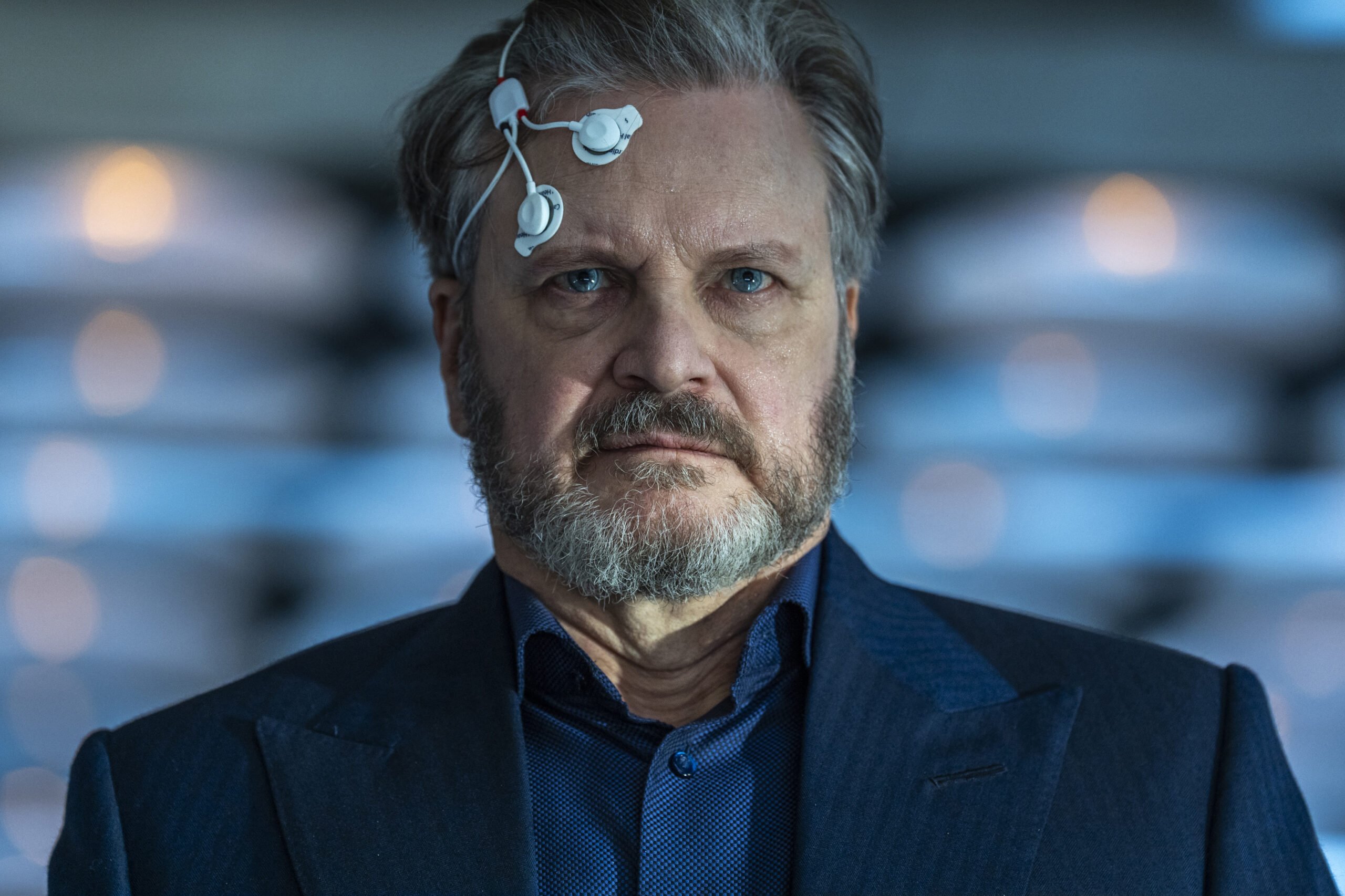
The person holding the rod in this scene is Noah Scanlon (Colin Firth), head of shadowy cybersecurity firm Wordex, who is hellbent on keeping human knowledge of extraterrestrials secret from the general public. Scanlon’s trying to find whistleblower Daniel Kellner (Josh O’Connor), who’s got all of those alien secrets tucked in a backpack while he’s on the run, and while Daniel’s more experienced mind is protected from diving, his girlfriend Jane’s (Eve Hewson) is not. So, monitored by medical personnel at Wordex headquarters (diving is dangerous), Scanlon pushes his way into Jane’s mind to find the location of Daniel’s safe house.
A telepathic invasion is scary enough on its own, but Spielberg doesn’t stop there. When Scanlon dives into Eve’s mind, he appears to her to be sitting across the kitchen table, like he’s in the room. Her bright blue eyes turn Scanlon’s dark brown, and she loses much of her control over her own body, not to mention her mind. Moments before, Daniel finally shared with her the secrets in his backpack, so Jane is shocked, conflicted, deeply vulnerable when Scanlon slips inside her head. This is not just telepathy. This is possession.
Spielberg underscores this not just through the visual language of the scene, as Jane breaks out in a sweat and struggles to sit upright as Scanlon invades her mind, but through Jane’s background. As she revealed to Daniel earlier in the film, Jane is a former novitiate nun who left her convent when she began to question her calling. She still believes firmly in God and, more importantly, believes that perhaps proof of alien life should be kept secret from the public because, in her eyes, it would upset the entire balance of faith in the world. God is a defining factor for humankind, Jane argues, and showing humanity proof of creatures from the stars would undercut that in dangerous ways.

This context, combined with the crucifix necklace Jane’s holding in her hand at the time of the dive, makes this scene the closest thing Spielberg will ever shoot to something out of The Exorcist. It’s not just a battle of wills, but a battle of faith. As an amoral technocrat worms his way into her memories, her beliefs, her faith, Jane turns the crucifix into a weapon, squeezing it until her hand bleeds when she discovers that a pain response can momentarily push Scanlon out of her head.
Of course, when you put a crucifix and a bloody hand together, it conjures images of stigmata. Screenwriter David Koepp pushes the allusion further by having Scanlon quote Christ on the cross to Jane by way of convincing her that she must be the one to stop Daniel by any means necessary.
It’s easy to see why this is scary, right?
On a very basic level, you have a powerful, wealthy man subduing and assaulting an innocent young woman, which is frightening enough. Then, the layers of the scene kick in. Scanlon doesn’t just assault Jane, but possesses her, seizes her memories, her knowledge, and finally her own free will, all while Jane literally clings to her faith in an effort to fight back. Disclosure Day is, among other things, a story about who has a right to the truth, and Scanlon believes that he should be the arbiter of that truth. Not just the truth as he sees it, but the truth as Jane sees it as well. If they don’t see eye to eye, he’ll make her.
But the possession, as it turns out, cuts both ways. Using the rod to dive is, for a normal human being, an intensely strenuous process. Scanlon admits that previous attempts almost killed him, and for some members of his time, so much as touching the rod results in a near-death experience. Even accessing an unprepared mind like Jane’s takes a lot of Scanlon, and when she kicks him out by squeezing the crucifix – again, so much meaning embedded in the details here – his team holds him back and tries to offer medical intervention. But Scanlon persists, pushing them away, and keeps diving back in.
This means that Jane can’t escape him because he just won’t stop pushing back through her defenses, but it also means that each time Scanlon enters her mind, and thus the safe house, he looks more monstrous. By the end, through a combination of lighting and makeup, Firth barely looks human, conjuring up images of the possessed Father Karras at the end of The Exorcist.

Colin Firth (center, standing) in DISCLOSURE DAY, directed by Steven Spielberg.
On a pure, visceral craft level, all of this is quite frightening, but the real trick to making this scene into Spielberg’s most terrifying lies in the more existential horror surrounding all of this. Disclosure Day is a film about the battle for the truth over extraterrestrials, but it’s also about a fight against an impossibly powerful surveillance state, the devaluing of human and alien lives in favor of some nebulous collection of assets, and the value of the individual in a world that increasingly lumps people into demographic boxes and writes them off.
In this scene, the surveillance state becomes supernatural, a human life is worth less than a piece of information, and an extragovernmental technocrat would rather sacrifice his own humanity than see reason. In 2026, few things could be more terrifying than that. Spielberg knows this and wields it mightily, proving once again that, while he’s not a strictly horror filmmaker, he can direct horror with the best of them.
Disclosure Day is in theaters now.

Eve Hewson (second from left) in DISCLOSURE DAY, directed by Steven Spielberg.
You must be logged in to post a comment.