Editorials
Six of the Best Chainsaws in Gaming!

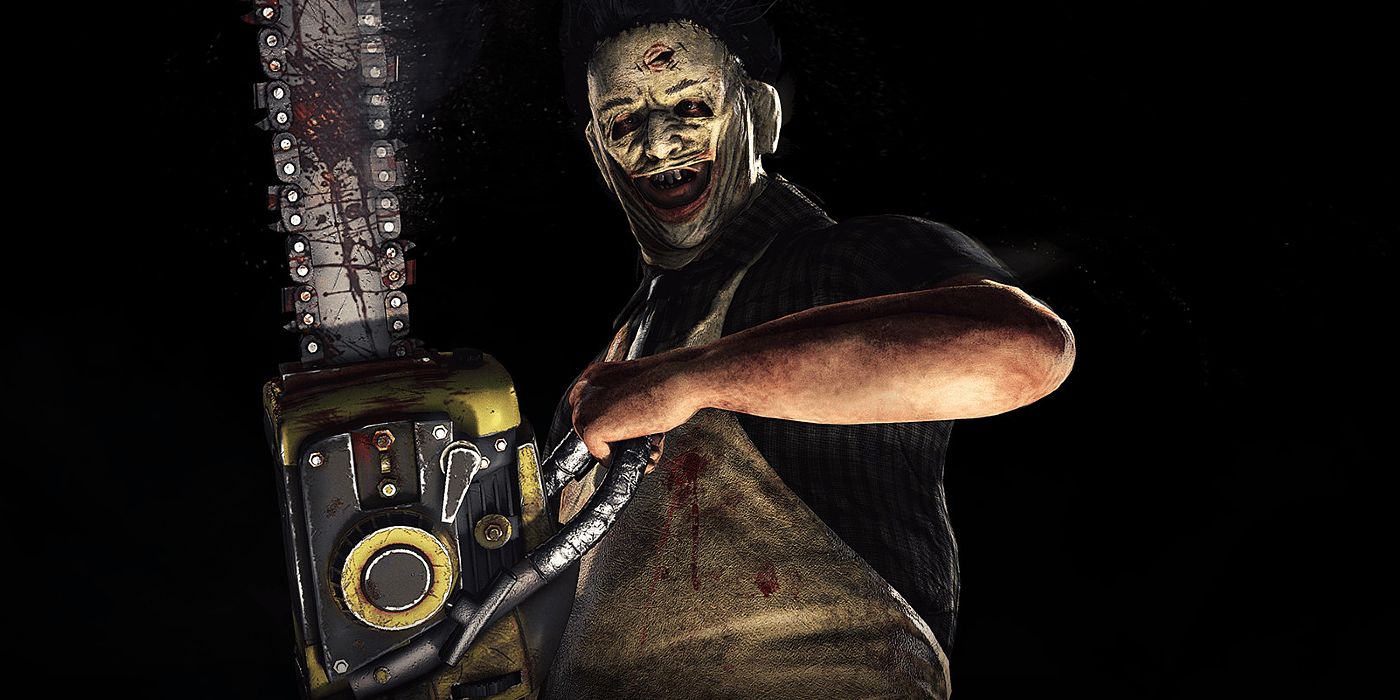
With both the Texas Chainsaw Massacre and Evil Dead franchises promising us brand new videogame adaptations in 2022, it appears that horror gamers have a lot to look forward to in the near future. At the very least, we’ll be having a lot of virtual chainsaw-related fun later this year, and that got me thinking about the popularity of chainsaws in the horror genre, especially when it comes to gaming.
From Leatherface’s unfortunately phallic-looking weapon in his 1983 outing on Atari consoles to to the online flash sensation Skull Kid, chainsaws just feel right as badass power-ups and are almost always satisfying to use. That’s why they’ve become so prevalent in gaming despite their real-world impracticality when it comes to anything other than boring old hard labor.
Of course, despite this popularity, not all digital chainsaws are created equal, so we’ve decided to come up with this list celebrating six of the best chainsaws in gaming! Since there are so many to choose from, we’ll be limiting our selection to player-controlled in-game weapons only. That means no Dr. Salazar from Resident Evil 4 or that limited edition PS2 controller shaped like a chainsaw. We also won’t be including any hybrid weapons, which excludes items like the iconic Lancer from the Gears of War series.
As usual, don’t forget to comment below with your own favorites if you think we missed an important one.
Now, onto the list of the best chainsaws in gaming!
6. Splatterhouse (2010)

Namco’s Splatterhouse reboot has a lot going for it. Sure, the engine is a bit janky and the levels can get irritatingly repetitive, but there’s a solid story by comic writer Gordon Rennie that keeps things interesting, and I just can’t get enough of Jim Cumming’s charming performance as the Terror Mask.
Of course, it’s the over-the-top violence that really makes a Splatterhouse title, and that’s where this virtual chainsaw comes in. First acquired after literally ripping it off the bloody arms of the infamous Biggy Man, this deadly weapon is actually a little bit too fun, as the gore-induced particle effects are so exaggerated that they often make the game lag. That’s why it’s on the bottom of this list despite being such a genuinely fun power-up.
5. Dead by Daylight (2016)

While it’s now known for its impressive array of licensed murderers, Dead by Daylight has always put a lot of effort into its original killers. Of the three playable antagonists that initially shipped with the game, I think the Hillbilly stands out as one of the most fun to control due to his absolutely devastating chainsaw attack.
While the saw has to be revved up in order to be used and players have to deal with an annoying cool-down period, it’s still one of the most insanely powerful weapons in the game, able to take down several survivors in a single hit if you can catch them all in a closed space. This insanely satisfying attack also gets bonus points for being featured in the game’s Leatherface add-on, which makes a lot of sense when you consider that the Hillbilly was directly inspired by Tobe Hooper’s iconic cannibal.
4. Silent Hill 2 (2001)

Silent Hill 2 is fascinating and hard to put down (not to mention one of my favorite games of all time), but I don’t think I’d call this depression simulator a traditionally “fun” experience. At least not during your first playthrough. When it comes to a New Game Plus, however, SH2 allows James Sunderland to re-enact his favorite Evil Dead moments with a familiar chainsaw that only spawns if you managed to get your hands on some fuel during your previous playthrough.
The Silent Hill 2 combat system may not be especially entertaining, but the sheer absurdity of wielding a weapon traditionally associated with B-movies inside an interactive adaptation of a Dostoyevsky novel is absolutely priceless. The chainsaw would show up again in later entries in the franchise, but I’ll never forget cutting down demonic nurses like a maniac while James cries about his dead wife.
3. Lollipop Chainsaw (2012)

With a name like that, it’s obvious that James Gunn (yes, that James Gunn) and Suda 51’s Lollipop Chainsaw would be making it onto the list. While this oddball hack n’ slash title is kind of an acquired taste, there’s something to be said about the schlocky thrills of chainsaw-ing zombies while taking control of a scantily clad cheerleader with a possible blood fetish.
Not only does Juliet’s titular chainsaw sport a custom pink finish, but the shaft is charmingly decorated with a tiny heart to let zombies know that they’re being killed with kindness. The title also gets bonus points for likely containing the most amount of dedicated chainsaw combos in any action game ever.
2. Mad World (2009)

There’s no denying that the Nintendo Wii was one of the most successful videogame consoles of all time. However, the Wii was also cursed with a reputation as “baby’s first console”, with most releases being targeted towards a younger audience. Of course, leave it to PlatinumGames to prove the critics wrong with their incredibly gory Mad World, a game that appropriately features a protagonist that can turn his arm into a freakin’ chainsaw.
Boasting Sin-City-inspired visuals, addicting gameplay and more action one-liners than you can shake a stick at, Mad World makes it onto this list because of how fun it is to set up chainsaw executions with the Wii’s motion controls. While the movements aren’t exactly precise, it’s a lot of fun to simulate a kill with your real hands and see it reproduced in beautifully bloody glory on the screen.
1. Doom (1993) to Doom Eternal (2020)

Present in every entry of this long-running series, I don’t think anyone will disagree about having Doom’s recurring ‘saws as our number one pick for the best chainsaws in gaming. After all, how can you say no to the franchise that created the double-barreled chainsaw?
Referred to as “the great communicator” by Doom-Guy in that infamous tie-in comic, this memorable weapon has been entertaining gamers for nearly three decades now. Not only does it break up the monotony with some close-quarters fun, but the constant revving also makes the badass soundtrack hit that much harder while you’re joyously eviscerating hell-spawn.




Editorials
Before ‘The Blair Witch Project’, ‘Alien Autopsy’ Showed How Real Found Footage Could Feel
The line separating artist from con man is a lot thinner than you might initially believe. While I think we can all agree that lying for the sake of profit is actively malicious behavior, isn’t it also true that the faux documentary aspect of The Blair Witch Project is half the reason why that film became such a cultural phenomenon? After all, if there’s one thing filmmakers have in common with stage magicians, it’s that misleading and misdirecting audiences is simply part of the job.
That’s why I’ve developed a habit of mostly ignoring the moral quandaries behind many of film and television’s biggest “hoaxes” in favor of appreciating the narrative elements that drive productions like Mermaids: The Body Found and even Animal Planet’s highly underrated The Cannibal in the Jungle. However, if there’s a definitive case of a highly publicized broadcast fooling the world into taking it seriously, it has to be Fox’s infamous 1995 TV special Alien Autopsy: Fact or Fiction.
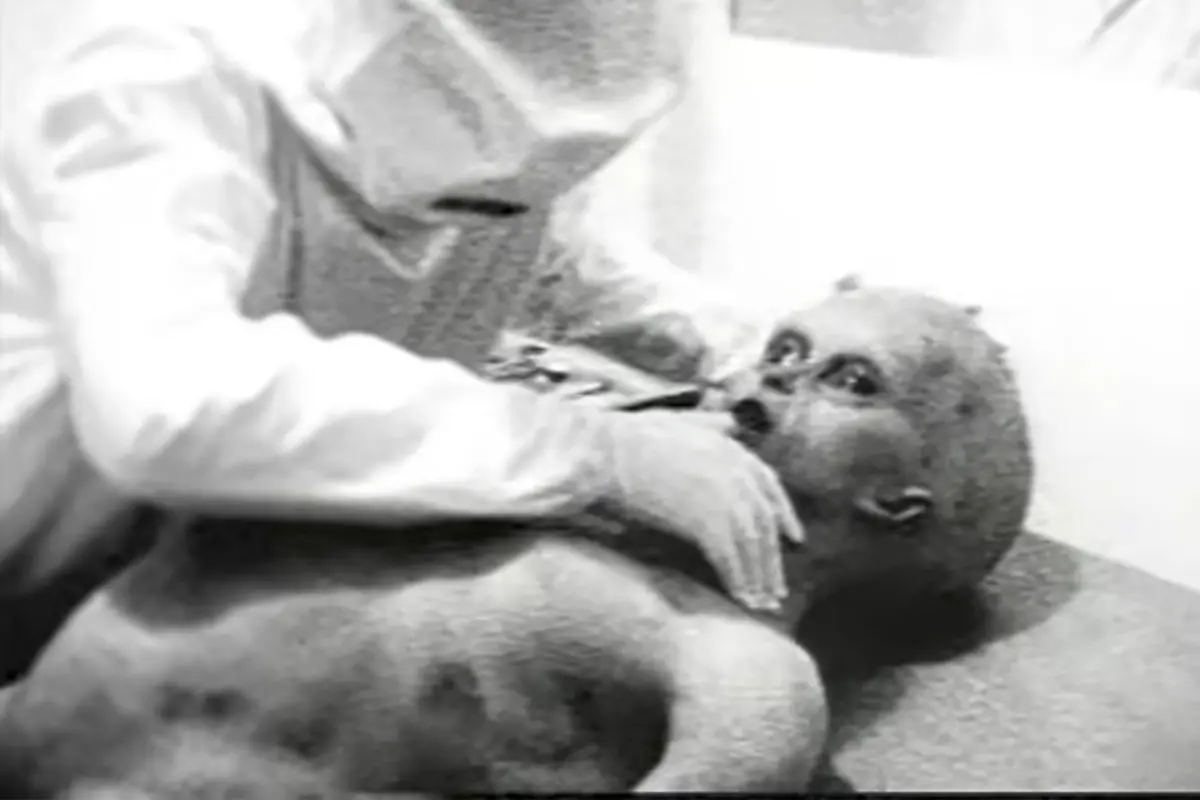
It’s been over three decades since that eerie footage first haunted television screens right at the peak of the ’90s ufology craze, and in that time, the video has taken on a life of its own. From countless parodies and references in everything from The X-Files to Tony Hawk’s Pro Skater (as well as John Dower’s recently released tell-all documentary The Alien Autopsy Scandal, which I’d highly recommend to genre fans everywhere), there’s no denying the legacy of the Alien Autopsy video. However, I rarely see the tape discussed as what it truly is: a highly convincing found footage film directed by a passionate stage magician and brought to life by masterful practical effects work.
That’s why I’d like to invite readers to join me on a deep dive into one of the most infamous broadcasts of all time in an attempt to reevaluate the footage as a fascinating narrative experience rather than a complete hoax.
The TV Special That Convinced Millions It Was Real

Ray Santilli next to Extraterrestrial replica in ‘The Alien Autopsy Scandal’
For starters, regardless of whether or not you believe that there was in fact an extraterrestrial crash in Roswell during the summer of 1947 and that some form of autopsy was performed on the victims, the producers behind the black & white recordings, Ray Santilli and Gary Shoefield, insist that their video was a “restoration.” Though I’d argue that the proper word is “remake”of genuine footage that was too damaged to air on television. That’s why the duo went on to recruit filmmaker and eccentric magician Spyros Melaris and sculptor/monster designer John Humphreys to bring their version of the autopsy to life and sell it to the highest bidder.
This is where the story of the Alien Autopsy as a narrative experience really begins. Melaris claims that his approach to the faux recording consisted of striving for extreme period accuracy in both shooting equipment and setting while also planting subtle details that would initially seem like mistakes but could later be revealed to actually fit the time period. That being said, the filmmaker was under the impression that the short would be released for free as a PR stunt, with the team later producing and selling an informative documentary chronicling exactly how the footage was faked and commenting on how easy it is to manipulate public perception with a good old-fashioned magic trick.
This obviously isn’t how things went down, and that’s likely the reason why Melaris has since distanced himself from everyone else involved with the project. Yet, no amount of behind-the-scenes drama can undermine the genuine effort that went into making the short as impressive as it is. From the sourcing of real animal organs from a local butcher to make the organic part of the creature more lifelike to the highly detailed sculpt that made use of a hollowed-out underlayer that could be filled with fake blood and assorted viscera, there’s a reason why so many Hollywood specialists are still impressed with the artistry on display here.
Of course, the believability is only half the story, as I think that the best part of the autopsy is how Melaris builds on the existing tension by obscuring certain details and often embracing the chaos of what a real examination of extraterrestrial life could feel like. The camera often goes out of focus at just the right time to make certain effects hit even harder, and we can only speculate as to what the hazmat-suited doctors are gesticulating about during the operation. There’s a real air of mystery to the whole thing that almost makes it feel like a cosmically terrifying, cursed film containing forbidden knowledge that civilians were never meant to see.
So when Fox’s Fact or Fiction brings in the specialists to comment on the film and its otherworldly subject, it’s no surprise that we end up with one of the most memorable mockumentaries of all time – albeit one where the participants are unaware that the footage they’re commenting on is basically a large-scale practical joke. A joke that the network was obviously in on, as many participants claim that the TV special cut out significant portions where guests point out that they believe the footage to be an elaborate hoax.
The Lasting Impact of the Hoax Turned Cultural Event

Regardless, I remember going to bed terrified after watching reruns of the special and thinking about the respected pathologist who claimed that the body was almost certainly inhuman, with even effects maestro Stan Winston commenting on how difficult it would be to recreate some of these visuals through practical puppetry. That’s not even mentioning Jonathan Frakes’ dramatic hyping up of the disturbing imagery as if he was talking about the tape from The Ring, with his spooky demeanor here likely being responsible for his later role as the host of Beyond Belief: Fact or Fiction a few years later.
Personally, I’d argue that the Alien Autopsy phenomenon had just as much of an impact on me as a horror fan as The Blair Witch Project, a film that was almost certainly influenced by the success of this immensely popular hoax (to the point where they even produced their own TV special commenting on Heather’s found footage). Even if Fox didn’t intend to produce a narrative feature about the aftermath of the Roswell crash, the end product still holds up remarkably well as a highly entertaining mockumentary exploring the idea that we may not be alone in the universe.
While neither Santilli nor the rest of the production team has ever commented on this, I also think it’s very likely that the idea of a faux Alien Autopsy could have been influenced by Dean Alioto’s The McPherson Tape/UFO Abduction. I’ve already written about how this granddaddy of found footage was co-opted by rogue ufologists who began selling bootlegs of the tape at conventions as if it were real evidence of a close encounter, so it’s not that much of a stretch to imagine that Santilli and company could have heard about this phenomenon and been inspired to come up with their own highly profitable hoax.
At the end of the day, it’s unlikely that the Alien Autopsy film is recreating any real footage from Roswell, but I can still appreciate the short and the accompanying television event as a standalone horror story that still influences the way we see found footage to this very day.
After all, the possibility that something could be real is often much scarier than finding out for sure – and that’s why I think Alien Autopsy: Fact or Fiction is still worth revisiting three decades down the line.
You must be logged in to post a comment.