


For all of the mysteries and “monsters” that the Mystery Inc. gang have confronted over the past 50+ years of their existence, it’s strange that the Scooby-Doo franchise has never built its identity solely around the horror genre. This is common for many children’s shows aiming for hints of horror, such as The Grim Adventures of Billy & Mandy, Are You Afraid of the Dark?, and Goosebumps to name a few, but the classic mysteries surrounding Mystery Inc. seem almost tailor-made to be explored in a darker genre.
The world’s most famous Great Dane and his squad of eager, adventure-driven teenagers have become a staple of American television history, serving as a leadership program for Hanna-Barbera alongside the likes of The Flintstones, Jetsons, Smurfs, and Yogi Bear. But, with the exception of The Smurfs, Scooby-Doo has managed to outlive the other programs in terms of relevancy and popularity. There are still countless iterations of the program, a strong standing in modern pop culture, and even a brand-new film called SCOOB! still due to release in May 2020 at the time of this writing.

Watching the trailer for that new film further exposed just how distant Scoob and the gang have become from their roots. The trailer was upbeat, poppy, and hinted at a doomsday scenario that we’ve seen with other blockbusters that became the norm in the 2010s. Not a bad thing to try and adapt to modern cinematic sensibilities and I’m personally super excited to see Scooby on the big screen again, but maybe the old head on my shoulders longs for the days when Scooby-Doo embraced its horror roots more strongly.
That being said, the original show was never that scary in the first place, placing emphasis on the mystery that the gang was trying to unravel and the goofy antics of Scooby and his best pal, Shaggy; cowardly on the surface, yet brave enough to continue on with the gang’s various adventures. They were the main source of comedy and personality in the show, so the horror aspects never went to any level beyond being chased around by a “monster” in a suit. The horror was always defeated and the gang reaffirmed their belief in monsters and ghosts not being real.
By the late 90s, this classic formula had all but worn out its welcome in the Scooby-Doo franchise, with spin-off after spin-off trying (and not usually succeeding) to mix up the formula while keeping its roots the same. The idea of “real” monsters was toyed around with, such as the supernatural Scooby-Doo Meets the Boo Brothers (a guilty pleasure of mine) and Scooby-Doo and the Ghoul School, but there was too much reluctance to delve deeper into the concept, leaving the franchise with something missing to reinvigorate the appeal of a “Scooby-Doo mystery.”
So when Time Warner decided to greenlight direct-to-video Scooby-Doo films in the late 90s after a surge in popularity from reruns, the creative team behind the films, particularly the first film, took this as an opportunity to thrust Scooby and the gang into a more taboo section of children’s horror, crafting stories that led Mystery Inc. to encounter not only real ghosts and monsters, but compelling and even disturbing settings heavily inspired by real-life events to give the stories a realistic edge to them while still retaining the comedy that the show became popular for.
The first four direct-to-video Scooby-Doo films from this time period also had help from Studio Mook, a Japanese animation studio that worked on the four films; and when you compare them to the future Scooby films, there’s a noticeable difference in how they look. The films’ animation felt cinematic and the darker tone allowed for the studio to play around with the lighting and creature design to give it that extra edge to match the films’ change in atmosphere.
As a result, these are the films that birthed from this surge of creativity.
Warning: Major spoilers for the four films from here on out. Read at your own risk.

Scooby-Doo! on Zombie Island, a reunion film for the gang as they investigate a possible haunting at a Louisiana estate leading to the discovery of real zombies (gasp!). Scooby-Doo! and the Witch’s Ghost, a supernatural tale of the gang looking into the mystery surrounding a witch disturbing a small New England town. Scooby-Doo! and the Alien Invaders, an odyssey through the desert of Roswell, New Mexico involving a potential alien invasion. Last, but not least, we have Scooby Doo! and the Cyber Chase, a digital adventure through a computer game plagued with a rogue virus bent on destroying the gang.
Of course, there have been countless direct-to-video Scooby-Doo movies since then, but the first four of this line of films represented a different era for the franchise, a darker and more socially relevant one if you will. These films not only tackled the concept of real monsters and ghosts, but brought forth an emphasis on social issues that are still debated to this day, such as conspiracy theories, mass hysteria, the horrifying truths behind piracy in the 18th century, etc. The Scooby-Doo films did not mess around with their subject matter, leading to noticeably more mature final products.
Zombie Island, the first and arguably best of the four films, is easily the darkest in sheer atmosphere, not to mention its grim subject matter. The creative team gave the zombies a tragic edge, being the long-dead victims of the cat creatures, Simone and Lena, who themselves became cursed after a band of pirates murdered the settlers living on the island two hundred years ago. For perhaps the first time, the gang encountered a situation that was morally gray at its core, with characters causing true acts of evil for both selfish and tragic reasons.
For this reason, Zombie Island was significantly more terrifying than any other Scooby projects in the past. It was an evolution for the franchise as the gang, clearly tired with the same old fake-out mysteries, finally dealt with a legitimate threat that threw their world upside down. Even the animation emphasized a darker tone, with shadows and darkness being used to cloud the frames, leaving the audience in the dark with the gang as they navigate through this genuinely compelling and even complex mystery.
Witch’s Ghost, released after Zombie Island, was lighter in tone, but still made use of real-life events to craft an intriguing mystery centered around the wishy washy truth behind historical figures and the mass hysteria that has defined the chaos concerning the Salem Witch Trials. With the addition of a real witch in the mix, the gang continued to come face-to-face with the truth of their American history (in terms of the film’s universe), exposing the simplicity in duping folks into believing anything they hear without question.

The use of the red herring grants the opportunity to add to the mass hysteria angle of Witch’s Ghost as well with the addition of the Hex Girls. Initially seen as mysterious girls with gothic-looking makeup, the girls are an easy target for the mystery despite only being Wiccan with no relation to the mystery itself. The film’s dark and moody presentation of them creates an uncomfortable feeling, further driving home the point of these films aiming to be scarier than the classic series we’re all used to.
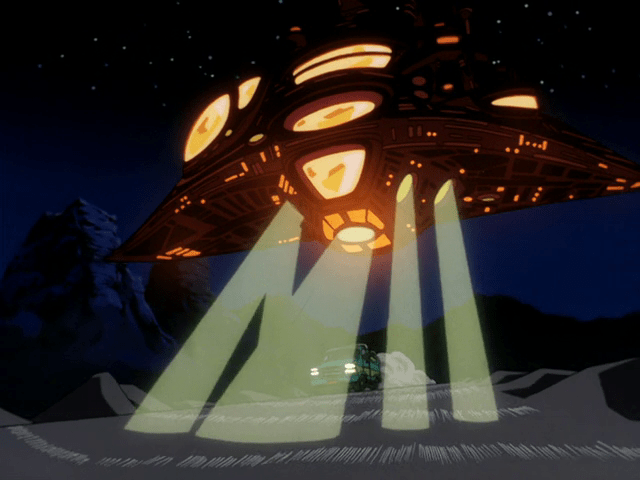
Alien Invaders is perhaps the most simple of the four films, seeding as how the true antagonists are just greedy criminals hungry for wealth. Still, the creative team was wise to include the mysteries surrounding the Roswell Incident to insert a conspiracy aspect to the film. Even when the true aliens eventually expose themselves, there’s an eerie hint of truth to the criminals praying on small-town sensibilities and naivety, as well as the story surrounding Roswell, for their advantage. Like Witch’s Ghost, the scariest aspect of this film is just how easily people can be fooled.
The Roswell angle ties this story to the real world in a similar manner to Witch’s Ghost as well, creating stronger parallels to the chaos surrounding what really happened in Roswell. Alien Invaders suggests that aliens do indeed exist, just hiding in plain sight (here in the forms of human Crystal and her dog, Amber). Interestingly, the aliens here are presented as peaceful, unlike the creatures and ghosts in the other films, perhaps as a way to demonstrate that the presence of humans may be far more dangerous than anything we might discover out there in space.
This theme remains relevant for Cyber Chase, where the main villain is actually a human responsible for creating this rogue virus within the game in an example of humanity’s potential to use the powers of modern technology for their own grim purposes. The film doesn’t contain the same grim tone that the previous three had to varying degrees, but the threat of death and being stranded inside the game remains the focal point of the adventure, presenting the gang with a different, yet equally high-stakes scenario to overcome.
In many ways, Cyber Chase was the metaphorical swan song for the classic Scooby-Doo franchise, transitioning into a new age while still keeping memories of the old locked away in their own paradise. These memories never die, just stay behind, and that’s arguably the most defining aspect of the four films. The films, released from 1998-2001, represented a step forward for Scoob and the gang in terms of their mysteries and they never shied away from presenting challenging and even disturbing content.
We can make fun of the four films’ stiff voice acting all we want, but witnessing innocent settlers being forced into a bayou filled with hungry alligators is something that even some horror films aren’t willing to show. Digital versions of the gang that are both sentient and fully accepting of their stagnancy in the game is something out of a sci-fi project. Explicitly showcasing Wiccan characters in a positive light (however accurate or inaccurate it may be) or expressing the idea of the government knowing more about the secrets of Roswell than they initially led on? These films were almost a complete departure from the original series and that’s what has made them stay popular despite coming out 20 years ago.

The films may still have the charm of the OG series, but they were willing to cross boundaries that only something like Courage the Cowardly Dog was willing to do for children’s cartoons. Perhaps the boom of the cowardly dog’s popularity led to this tonal shift for the series? It wouldn’t surprise me, but it’s left me happy that we have these iterations to look back on as examples of the Scooby trying its hardest to disturb its viewers and succeeding to some extent. Sure, the films never quite reached the horrific highs of Zombie Island, but they nonetheless added to the series in their own ways.
Scooby-Doo would transition into a more comedic role in television, some would say back to their roots, and the movies that followed the Mook Tetralogy (Mook being the Japanese animation studio that worked on the four films) reflected this change for the franchise. The appeal was back to the gang’s comedic chemistry and the technical mysteries themselves rather than the complications surrounding them. Scooby-Doo was never even remotely close to being scary ever again, but maybe it’s for the best? Some things are truly meant to be left in the past and this era of more horror-themed Scooby adventures can stand alone as features we can happily revisit anytime. They’ll always be there in the end.
Wait, I forgot about Scooby-Doo: Mystery Incorporated! But I’ve written enough as is, so we’ll leave that for another day…