Editorials
Flight and Fright: Richard Matheson’s “Nightmare at 20,000 Feet” and Its Many Adaptations

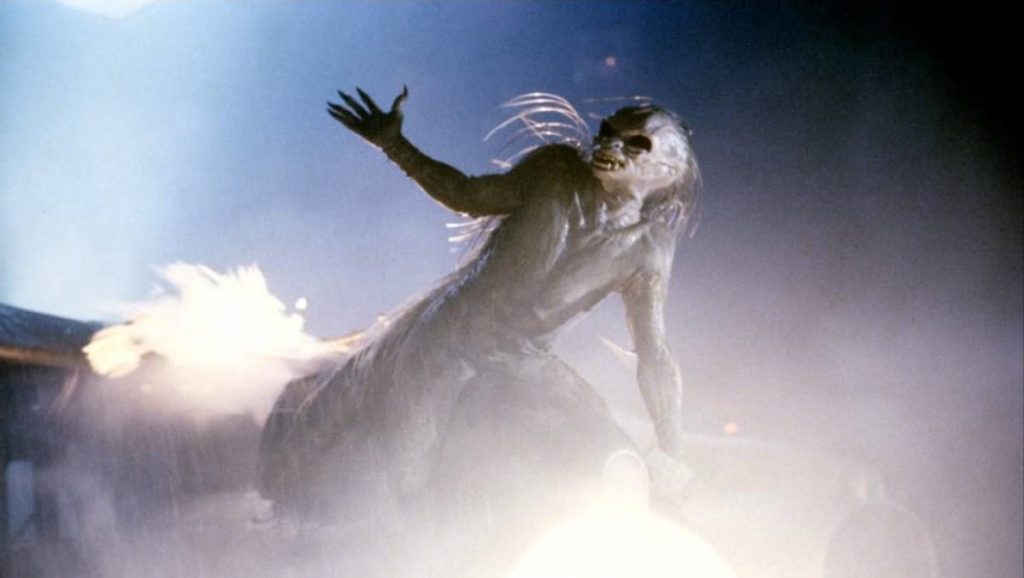
After nearly 60 years, Richard Matheson’s short story “Nightmare at 20,000 Feet” still packs the same ice-cold punch to the gut that it did back when it was first published and continues to reign as one of the finest horror tales ever conceived. It’s an expertly-crafted and seminal work and has been adapted for the screen twice and was most recently paid homage in an episode of Jordan Peele’s reboot of The Twilight Zone.
First appearing in the anthology Alone by Night in 1961, the story is perhaps Matheson’s best known and serves as a textbook example of his mastery over the delicate art of short fiction writing. The plot is probably familiar to most people: businessman Robert Wilson’s flight home quickly turns into a sweat-soaked, pitch-black carnival ride through his own sanity after he sees a mysterious creature on the wing of the airplane.
It’s a relentless and breath-stealing story that clamps onto you like a bear trap and refuses to let go until its abrupt and maddening conclusion, when Wilson is carted away in an ambulance, and we’re left with nothing but the burden of deciding for ourselves if what happened was real or not.

In a 2002 interview with the Television Academy Foundation, Matheson recalls the idea coming to him when he was on a plane himself and imagined a man skiing on the clouds outside his window. The concept quickly turned into something far more sinister, resulting in the classic tale. The first draft provided a lot more background to Wilson’s character, following him from his office, to his house, to the airport, until finally arriving on the place. But, as Matheson describes in the story notes in Richard Matheson: Collected Stories: Volume Three: “I don’t recall if I decided or if it was one of the editors who asked me if I could get to the story sooner so I just—bang!—put him into the airplane and started from there.“*
This decision, whoever was responsible for it, helped turn “Nightmare at 20,000 Feet” into the white-knuckle masterwork it is. Part of what makes the story work so well is the almost immediate leap we make into the titular nightmare. We are planted next to Wilson moments before take-off, perhaps the most exciting and nerve-wracking moment of any flight. With no time to get acquainted with our protagonist, or even find out where we’re going, it’s wheels up and there’s no getting out until the plane touches ground again. Like Wilson, we are trapped, with little to do but lay at the mercy of the events as they unfold.
When carried over to the screen, this instantaneous setup works even better, leaving little room for filler and unnecessary sub-plots. “Nightmare at 20,000 Feet” is perfect for the in-and-out, almost impersonal nature of anthology television and film, which is why both adaptations work so well. Both retellings closely follow the plot, each telling its own story, while presenting a unique interpretation of the main character.

William Shatner played the first on-screen version of Wilson in a 1963 episode of The Twilight Zone, which was actually scripted by Matheson himself and directed by Richard Donner (Superman, Lethal Weapon). Straying from the source material, this version of Wilson isn’t travelling for business, but is returning home after a 6-month stay in a mental hospital, where he went after suffering a nervous breakdown. When he begins to see the creature, he tries very hard to maintain his composure and dignity, always very aware that the slightest hint of erratic behavior could land him back in the hospital.
In another divergence from the original story, Wilson is travelling with his wife, who serves as a frustratingly staunch non-believer of the goings on, and to continuously remind him of his illness. The addition of this character puts a huge burden on the audience, asking us to believe Wilson when not even his spouse will do so. It’s a fantastic change and gives the narrative a new dimension that probably wouldn’t have worked as well on the page.
This is a far cry from what we get in the second adaptation, which appeared as a segment in 1983’s Twilight Zone: The Movie. This version was also scripted by Matheson and was directed by George Miller, creator of the Mad Max series. John Lithgow (3rd Rock from the Sun, Dexter) takes the lead role here and, unlike Shather’s reserved and nuanced performance, his character is a complete neurotic mess from the beginning. John Valentine is a sweaty, tightly-wound bundle of nerves, which erases any potential for credibility and makes it even more difficult for the crew to believe his story. Lithgow dives right into the role, executing the paranoia and madness perfectly.

Both versions also differ greatly in the design of the monster and this is where the movie version definitely overshadows the TV one. In the Television Academy interview, Matheson describes how he disliked the 1963 costume, referring to it as “a wooly bear”. And he’s certainly not wrong. The 1963 monster is awkward and apelike with a very obvious man-in-suit quality to it. The 1983 version, on the other hand, is a lot scarier and much more worthy of the source material.
By scripting both adaptations himself, Matheson was free to take the protagonist and the plot itself into new directions, allowing him to expand on his original vision and break the plot out of its shell. The most significant change Matheson makes, however, comes at the very end. In the original story, the plane is forced to land after Wilson throws open the emergency hatch in an effort to get the creature off of the wing. Afterward, Wilson is hauled off in an ambulance, and it’s up to the reader to decide whether or not his vision was real. Both the 1963 and 1983 versions, however, remove all of that doubt. Matheson’s script instead calls for one final twist, in which it is revealed that the wing is severely damaged, proving to the audience and the other characters that Wilson/Valentine had been right all along and that he actually saved the plane.
This daring addition turns the story in a completely different and far more interesting direction and presents a terrifying truth—that the monster was real. In a visual medium like television, this twists works far better than the original ending, leaving no room for doubt in the audience’s mind about what really happened, but giving us something even more perplexing to ponder—what in the hell was the thing on the wing?
The scariest thing about the creature—which Matheson identifies as a gremlin–isn’t simply its desire to wreck the airplane, which in itself is deeply unsettling. It’s how much it enjoys toying with Wilson, as if it’s completely aware of the fact that the flight crew don’t believe him and is doing whatever it can to provoke him.

This bizarre cat and mouse relationship between Wilson and the gremlin is most prevalent in a 3rd, semi-official retelling of the story. As a child of the 80s and 90s, I wouldn’t be able to forgive myself if I didn’t throw a little love to this version, which is classified as a parody rather than an official adaptation. This is also the version that would have introduced the story to most people under 40 years old. 1993’s The Simpson’s: Treehouse of Horror IV featured its own micro-sized version of “Nightmare at 20,000” feet, replacing the airplane with a school bus, and Robert Wilson for Bart Simpson.
Bart Simpson, a known troublemaker and liar is the perfect pawn for the gremlin’s devious plot. It’s as if it knows that no one will believe Bart’s tall tale, allowing it poke, prod and tear at the school bus with glee, all the while smiling and almost laughing at the only person who can see it. This version of the monster is much scarier that the others because it actually acts with joy and a complete understanding of what it’s doing.
The Simpsons’ take is a worthy and delightful addition to the story’s legacy. When I asked author Richard Christian Matheson, Richard Matheson’s son, about how his father felt about The Simpsons’ handling of his work he responded simply: “He loved it.”
When the new version of The Twilight Zone was first announced in December 2017, many hoped that it would include yet another adaptation of the story. This hope was fueled last October when one of the episode titles was announced as Nightmare at 30,000 Feet. Hopes and expectations were quickly dashed, however, when the series premiered on April 1, and it became clear that the episode was a loving homage to Matheson’s work, and not an official retelling.
“Nightmare at 30,000 Feet” is a completely original story (conceived by Peele and Simon Kinberg) and offers a paranormal examination of the post-September 11th skies, where anyone could be a threat, and any hint of erratic behavior is met with suspicion and hostility. Scriptwriter Marco Ramirez and Director Greg Yaitanes deliver an intense experience, with Matheson’s influence permeating everything we see on screen. Though it’s completely gremlin-free, paranoia, mental illness, and claustrophobic terror are all on display, and Adam Scott’s performance stands tall alongside Shatner and Lithgow’s.
Whether it’s a story of man versus monster, or man versus himself, “Nightmare at 20,000 Feet” pits both its protagonist and the audience against a mysterious foe that seeks not only to destroy human life, but to revel in the fear it is causing. It is a landmark in the history of horror fiction, melding mental illness, paranoia and the primal instinct for survival into a dizzying narrative that has been told and re-told for decades and will continue to inspire horror on the page and on the screen for decades to come.

* Matheson, Richard. “Nightmare at 20,000 Feet: Story Notes.” Richard Matheson: Collected Stories: Volume Three. Ed. Stanley Wiater. Colorado Springs: Gauntlet Press, 2005. 139-140. Print




Editorials
Before ‘The Blair Witch Project’, ‘Alien Autopsy’ Showed How Real Found Footage Could Feel

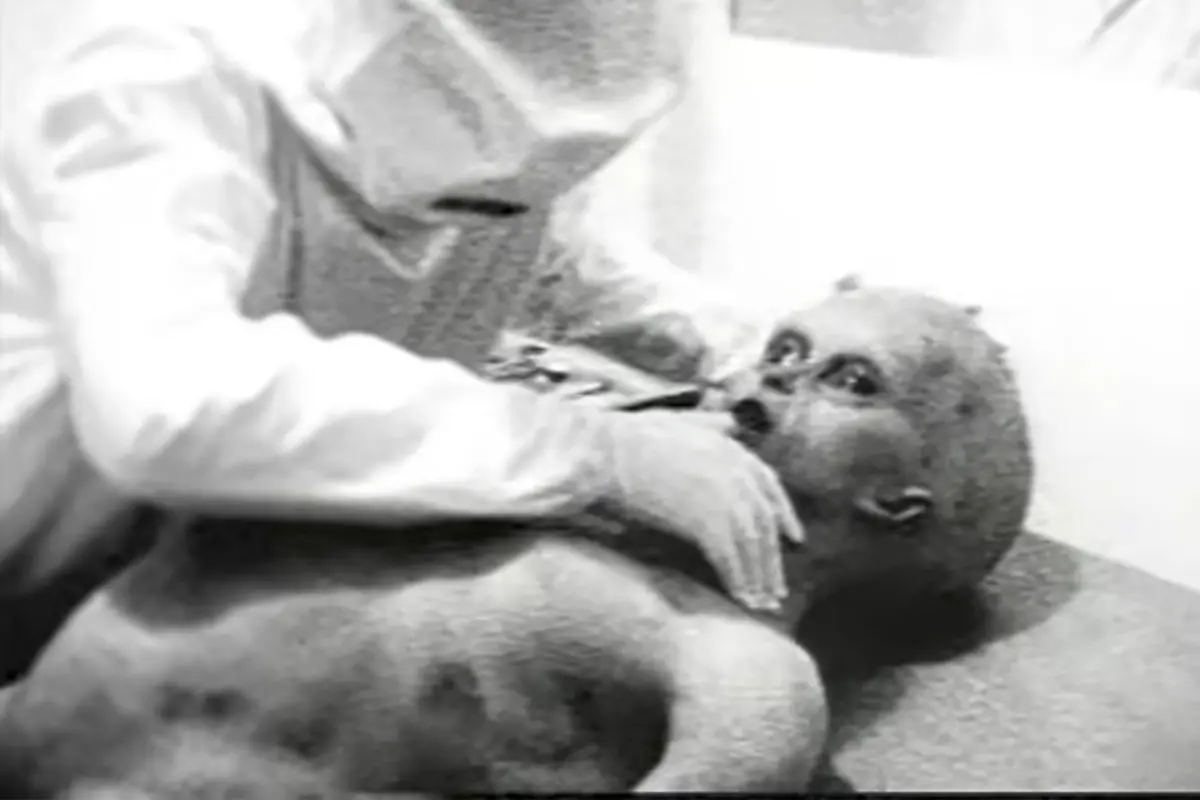
The line separating artist from con man is a lot thinner than you might initially believe. While I think we can all agree that lying for the sake of profit is actively malicious behavior, isn’t it also true that the faux documentary aspect of The Blair Witch Project is half the reason why that film became such a cultural phenomenon? After all, if there’s one thing filmmakers have in common with stage magicians, it’s that misleading and misdirecting audiences is simply part of the job.
That’s why I’ve developed a habit of mostly ignoring the moral quandaries behind many of film and television’s biggest “hoaxes” in favor of appreciating the narrative elements that drive productions like Mermaids: The Body Found and even Animal Planet’s highly underrated The Cannibal in the Jungle. However, if there’s a definitive case of a highly publicized broadcast fooling the world into taking it seriously, it has to be Fox’s infamous 1995 TV special Alien Autopsy: Fact or Fiction.
It’s been over three decades since that eerie footage first haunted television screens right at the peak of the ’90s ufology craze, and in that time, the video has taken on a life of its own. From countless parodies and references in everything from The X-Files to Tony Hawk’s Pro Skater (as well as John Dower’s recently released tell-all documentary The Alien Autopsy Scandal, which I’d highly recommend to genre fans everywhere), there’s no denying the legacy of the Alien Autopsy video. However, I rarely see the tape discussed as what it truly is: a highly convincing found footage film directed by a passionate stage magician and brought to life by masterful practical effects work.
That’s why I’d like to invite readers to join me on a deep dive into one of the most infamous broadcasts of all time in an attempt to reevaluate the footage as a fascinating narrative experience rather than a complete hoax.
The TV Special That Convinced Millions It Was Real

Ray Santilli next to Extraterrestrial replica in ‘The Alien Autopsy Scandal’
For starters, regardless of whether or not you believe that there was in fact an extraterrestrial crash in Roswell during the summer of 1947 and that some form of autopsy was performed on the victims, the producers behind the black & white recordings, Ray Santilli and Gary Shoefield, insist that their video was a “restoration.” Though I’d argue that the proper word is “remake”of genuine footage that was too damaged to air on television. That’s why the duo went on to recruit filmmaker and eccentric magician Spyros Melaris and sculptor/monster designer John Humphreys to bring their version of the autopsy to life and sell it to the highest bidder.
This is where the story of the Alien Autopsy as a narrative experience really begins. Melaris claims that his approach to the faux recording consisted of striving for extreme period accuracy in both shooting equipment and setting while also planting subtle details that would initially seem like mistakes but could later be revealed to actually fit the time period. That being said, the filmmaker was under the impression that the short would be released for free as a PR stunt, with the team later producing and selling an informative documentary chronicling exactly how the footage was faked and commenting on how easy it is to manipulate public perception with a good old-fashioned magic trick.
This obviously isn’t how things went down, and that’s likely the reason why Melaris has since distanced himself from everyone else involved with the project. Yet, no amount of behind-the-scenes drama can undermine the genuine effort that went into making the short as impressive as it is. From the sourcing of real animal organs from a local butcher to make the organic part of the creature more lifelike to the highly detailed sculpt that made use of a hollowed-out underlayer that could be filled with fake blood and assorted viscera, there’s a reason why so many Hollywood specialists are still impressed with the artistry on display here.
Of course, the believability is only half the story, as I think that the best part of the autopsy is how Melaris builds on the existing tension by obscuring certain details and often embracing the chaos of what a real examination of extraterrestrial life could feel like. The camera often goes out of focus at just the right time to make certain effects hit even harder, and we can only speculate as to what the hazmat-suited doctors are gesticulating about during the operation. There’s a real air of mystery to the whole thing that almost makes it feel like a cosmically terrifying, cursed film containing forbidden knowledge that civilians were never meant to see.
So when Fox’s Fact or Fiction brings in the specialists to comment on the film and its otherworldly subject, it’s no surprise that we end up with one of the most memorable mockumentaries of all time – albeit one where the participants are unaware that the footage they’re commenting on is basically a large-scale practical joke. A joke that the network was obviously in on, as many participants claim that the TV special cut out significant portions where guests point out that they believe the footage to be an elaborate hoax.
The Lasting Impact of the Hoax Turned Cultural Event

Regardless, I remember going to bed terrified after watching reruns of the special and thinking about the respected pathologist who claimed that the body was almost certainly inhuman, with even effects maestro Stan Winston commenting on how difficult it would be to recreate some of these visuals through practical puppetry. That’s not even mentioning Jonathan Frakes’ dramatic hyping up of the disturbing imagery as if he was talking about the tape from The Ring, with his spooky demeanor here likely being responsible for his later role as the host of Beyond Belief: Fact or Fiction a few years later.
Personally, I’d argue that the Alien Autopsy phenomenon had just as much of an impact on me as a horror fan as The Blair Witch Project, a film that was almost certainly influenced by the success of this immensely popular hoax (to the point where they even produced their own TV special commenting on Heather’s found footage). Even if Fox didn’t intend to produce a narrative feature about the aftermath of the Roswell crash, the end product still holds up remarkably well as a highly entertaining mockumentary exploring the idea that we may not be alone in the universe.
While neither Santilli nor the rest of the production team has ever commented on this, I also think it’s very likely that the idea of a faux Alien Autopsy could have been influenced by Dean Alioto’s The McPherson Tape/UFO Abduction. I’ve already written about how this granddaddy of found footage was co-opted by rogue ufologists who began selling bootlegs of the tape at conventions as if it were real evidence of a close encounter, so it’s not that much of a stretch to imagine that Santilli and company could have heard about this phenomenon and been inspired to come up with their own highly profitable hoax.
At the end of the day, it’s unlikely that the Alien Autopsy film is recreating any real footage from Roswell, but I can still appreciate the short and the accompanying television event as a standalone horror story that still influences the way we see found footage to this very day.
After all, the possibility that something could be real is often much scarier than finding out for sure – and that’s why I think Alien Autopsy: Fact or Fiction is still worth revisiting three decades down the line.
You must be logged in to post a comment.