
Home Video
Review: Criterion’s ‘Antichrist’ Blu-Ray

While Danish director Lars von Trier’s films dwell outside the mainstream realm, the topics he explores are as commonplace as they come. It’s his stance on these matters that challenges the viewer, causing them to see things from a viewpoint that is both so ugly and far removed from traditional thinking that it becomes almost as alien as it is difficult to comprehend. Antichrist, the autuer’s latest, follows this formula closely, yet also has the distinction of overloading those who dare watch the now infamous film – you’ve seen worse, trust me – with so many gloomy viewpoints and surreal images that the film could, and has, appeared to some as being about nothing. In a way, it is; the state of despair and madness that She (Charlotte Gainsbourg) exists in is so deep that her depression is nothingness, an emotional state where the darkness is so consuming that nobody can relate to where she is mentally or physically.
 Made as a therapeutic attempt to revive von Trier out of a bout of deep depression, Antichrist tells the story of a couple who recently lost their child during a rough and rigorous love-making session. She, who has fallen into a deep state of despair and is blaming herself for catering to her own carnal needs rather than giving her toddler the attention they needed while finding their way towards an open window, spends most of her days unable to get out of bed and function. He (Willem Dafoe), a psychiatrist, takes her out to the cabin where she took their child while writing her thesis on gynocide, and attempts to get their marriage back to normal through therapy, both sexual and traditional. The separation from the outside world, which one would reason to have a positive effect as city life stress would be non-existent there, instead drives her mad, causing her to contemplate the evil of women and nature.
The film, told in four acts with a prologue and epilogue (Grief, Pain (Chaos Reigns), Despair (Gynocide), and The Three Beggars), moves through the stages of emotion dealing with loss, starting with the event and leading all the way to the subject’s recovery – or absence of it. These areas brush topics not uncommon to von Trier’s work – misogyny, the downfall of relationships, self-humiliation – but here it’s presented in a way for all to see; as far as subtext goes, there’s not much here. The horror of She’s madness is there for all to see (explicit, cold and ugly), leaving very little to your imagination or personal interpretation. The bleak tone of the film appropriately matches She’s mindset, presenting a world that God has abandoned, leaving those in it as Satan’s playthings. The universe in which He and She physically live in – not mentally, they’re eons apart – is one where evil and the feelings associated with it are the only constants; there is no escape from it.
DP Anthony Mantle’s camerawork is varied and stylish, utilizing a grab bag of techniques to amplify the mental instability of She. The black and white opening prologue is stunningly shot, and the more surreal sequences are ably handled. Gainsbourg and Dafoe go above in beyond in crafting their characters, especially the former, who appears so convincingly crazy that she might be the only person on earth who worked their way into von Trier’s depression riddled mindset without having experienced the specific events that got him there.
Criterion’s Blu-Ray transfer is a noticeable step up from M6’s French disc, being encoded in 1080p rather than 1080i. Shot digitally with both a RED One and Phantom HD camera, Antichrist‘s release isn’t reference material, but it does provide an accurate representation of its intended visual appearance. Containing handheld camerawork, slow-motion, and black and white sequences, the contrast between the worlds He and She both occupy and live apart in is presented with exceptional clarity, aesthetic tweaks aside. The sharpness of the picture makes the more startling images even more so, especially the outdoor scenes. Even though most of the film is rather ugly and mainly operates with a grayscale color palate, the greens of the forest pop off screen. The DTS-HD Master Audio 5.1 track is on par with the transfer: it’s great considering the intended nature of its presentation. While not a particularly noisy film, the classical music throughout comes through with immense clarity, and most of the dialogue is crisp and clear sounding. Some of it sounds muffled, but according to the commentary track, the low mumbling of certain lines is intentional. Criterion’s special features are as bountiful for Antichrist as they are for most of their releases, porting over all of the foreign release extras. There’s a fair amount of overlap, and a few instances of conflicting stories, but the documentaries and interviews are very insightful into the process of making the film and the reactions to it. The biggest downside to the release unfortunately lies here, which is that there is no `play all’ option for the featurettes that are grouped together in sub-menus. Also included in the set is a 28-page booklet containing the essay All Those Things That Are To Die by professor and author Ian Christie.
Antichrist can be more easily compared to a painting rather than other films, in that it seems to exist as something worth studying and admiring rather than to entertain and be enjoyed. I won’t blame anyone that can’t stomach or make sense of the overabundance of ideas and seemingly disconnected imagery for not liking it, but in the end it evokes a strong reaction good, bad or otherwise, and it’s an experience that is not easily shrugged off or forgotten.
Special Features
Commentary – Lars von Trier is joined by film professor Murray Smith for the commentary track, which is both informative and frustrating at the same time. Von Trier, like myself on occasion, seems like he has too many things running through his mind to get a coherent sentence out of his mouth, and is often at a loss of things to say. I got an opportunity to interview von Trier last year, and while I will say I was extremely honored to speak with him about a film I consider to be extremely important, a public speaker he isn’t, and that sadly comes across here as well. The two men cover a variety of topics (intelligently, I might add), such as subtext interpretation, influences, technical aspects, and the message of the film (or lack thereof), but the director is the victim of not being to articulate himself properly. His brilliance is evident, just not as often as you’d like.
Cast And Director Interviews (67:04) – A group of three interviews, each focusing on a key member of the film. Confessions About Anxiety focuses on the mindset and approach used by von Trier when writing the film, which he did while in a deep state of depression; and Charlotte Etc. and Willem Dafoe: Agent Of Fantasy are interviews with Gainsbourg and Dafoe, respectively, where they talk about how they got cast, their experience on the set with von Trier as he worked through a very dark period, and the post-premiere controversy surrounding the film.
The Making Of Antichrist (64:14) – Split into seven sections, this making-of doc goes through the entire process of creating the film, from conceptualization to its eventual completion, with many of the featurettes focusing on one member of the creative team. Behind The Test Film looks at the different visual techniques experimented with in early test footage, which had a different cast; Visual Style focuses on DP Anthony Mantle and the styles and techniques he brought to the table; Sound And Music shows how sound designer Kristian Andersen created a different kind of horror soundtrack; Eden – Production Design covers the process Karl Juliusson went through when designing the look of the film; Makeup Effects And Props showcases the effort put forth by Morten Jacobsen and Thomas Foldberg in creating some of the more mind-searing effects sequences; The Three Beggars is a look at the animals in the film and what they represent, and includes an interview with animal handler Ota Bares; and The Evil Of Woman explores the information von Trier had researcher Heidi Laura gather to display the aforementioned topic in his film.
Cannes 2009 (21:45) – A companion piece to the making-of doc, this footage shows the chaotic nature of promoting the film at Cannes, and does indeed contain the now infamous “You’ve brought your film here, and you have to explain why you made it” snippet, which should make anyone who’s familiar with the director’s work and ego chuckle. Also included are more interviews with Gainsbourg and Dafoe, which contain a fair amount of overlap of information given elsewhere on the release.
Film: 4.5/5
Blu-Ray: 4/5


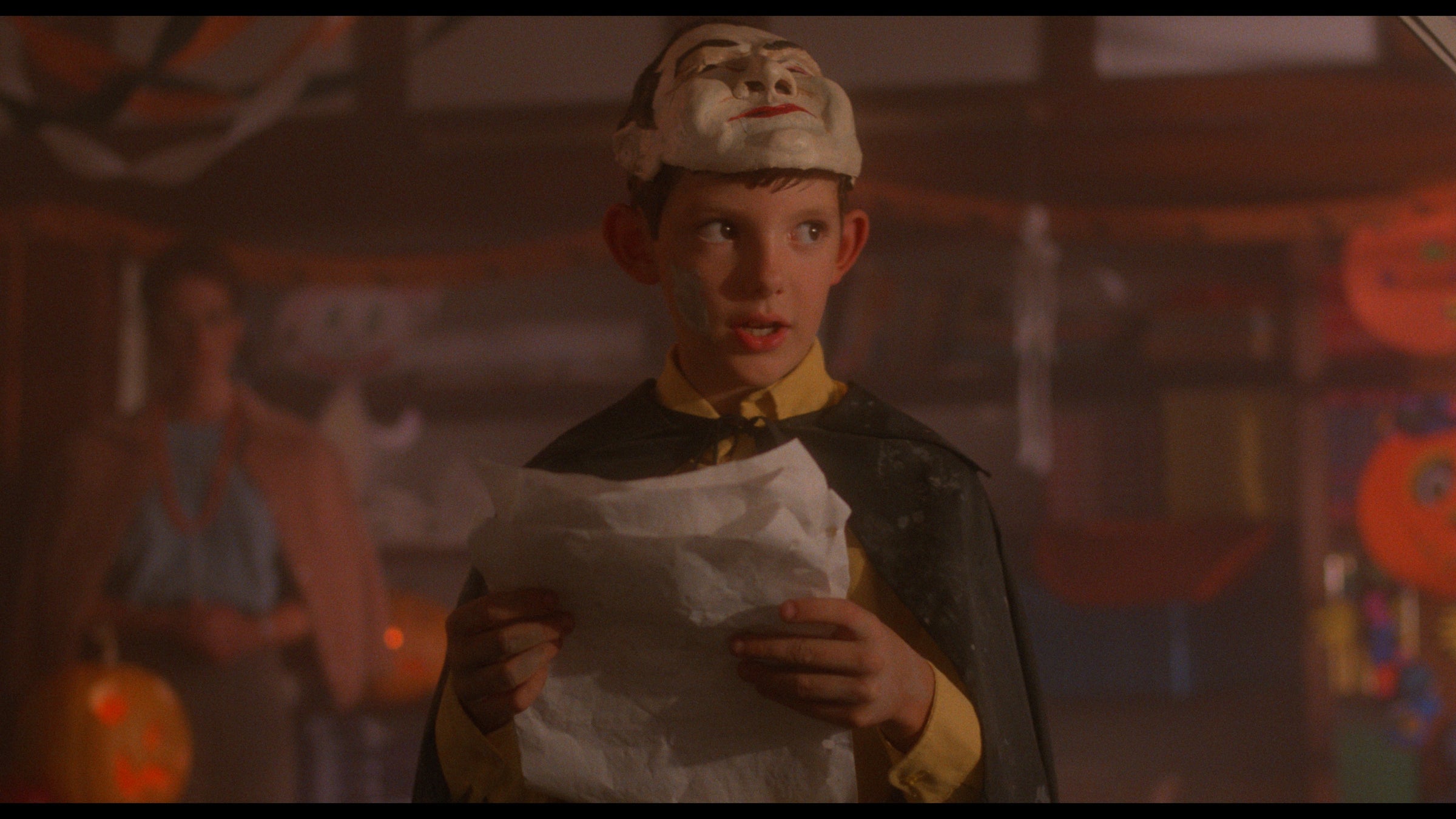
Scream Factory brought Frank LaLoggia’s 1988 Halloween movie Lady in White to Blu-ray several years back, and now Vinegar Syndrome gives the film a 4K Ultra HD upgrade.
Vinegar Syndrome’s Lady in White 4K release is available now and shipping now!
Watch the trailer below and grab your copy from Vinegar Syndrome today.
This limited edition 4-disc 4K UHD/Blu-ray x 3 set comes with a spot gloss hard slipcase + slipcover combo (designed by Dylan Haley), includes a 40-page perfect bound book and is limited to 8,000 units. It is only available on their website and at select indie retailers.
The full Special Features package includes…
- 4-disc Set: 1x 4K Ultra HD (High Bitrate BD100) / 3x Region A Blu-ray
- 4K UHD presented in Dolby Vision High-Dynamic-Range
- Newly scanned & restored in 4K from its 35mm original camera negative
- Presented in three versions: 126-min Pre-Release Director’s Cut (UHD+BD), the 118-min Extended Home Video Cut (BD), and the 113-min Theatrical Cut (BD)
- New group commentary track with writer/director Frank LaLoggia, alongside actors Lukas Haas, Joelle Jacobi, and Len Cariou for the Pre-Release Director’s Cut
- New commentary track with Frank LaLoggia, moderated by Scott Neumyer for the Extended Home Video Cut
- New commentary track with authors Emma Westwood and Stephen A. Russell for the Extended Home Video Cut
- Archival commentary track with Frank LaLoggia for the Extended Home Video Cut
- “Learning How to Fly” (10 min) – an interview with actress Karen Powell
- “A Snapshot in Time” (9 min) – an interview with actress Lisa Taylor
- “Human Touches” (6 min) – an interview with actress Lucy Lee Flippin
- “Still Relevant” (16 min) – an interview with actress Rose Weaver
- “75% Listening, 25% Editing” (9 min) – an interview with editor Steve Mann
- “Welcome to Willowpoint Falls” (6 min) – a location featurette hosted by Benjamin Scrivens, founder of Fright-Rags
- “Dream Talking: Looking Back” – a visual group commentary for the Pre-Release Director’s Cut with Frank LaLoggia, and actors Lukas Haas, Joelle Jacobi, and Len Cariou (103 min)
- Deleted Scenes with introduction and optional commentary by writer/director Frank LaLoggia (36 min)
- Behind-the-scenes footage with introduction and optional commentary by writer/director Frank LaLoggia (16 min)
- Extended behind-the-scenes footage (73 min)
- Introduction from the 20th anniversary dvd release
- Promotional ‘industry sales’ trailer (7 min)
- 40-page perfect bound book with essays by film historians Molly Henery, Mark H. Harris, and Heidi Honeycutt (limited edition only)
- Multiple radio spots
- Theatrical trailer
- Multiple TV spots
- Workprint trailers (7 min)
- Still gallery
- Reversible sleeve artwork
- English SDH subtitles
1962. Nine-year-old Frankie Scarlatti enjoys a homespun childhood in a rustic Western New York town. The entire community gets into the spirit of Halloween, but then two bullies prank Frankie by locking him in his school cloakroom, leaving him trapped for the night. Alone and afraid, his slumber is interrupted when the ghost of a little girl appears, and Frankie witnesses the specter of her murder by an unseen assailant. Later, while recovering at home, the girl’s ghost appears to him again. With help from his older brother, Frankie begins investigating the circumstances of her death. He soon discovers that her murder was one of several unsolved crimes connected to a local child-killer. As the town’s bucolic veneer fades and long-buried secrets and tensions bubble to the surface, all of the clues to the mystery seem to point towards a huge mansion inhabited by a reclusive woman known as “The Lady in White.”
A nostalgia-driven ghost story wrapped within an intricate murder mystery and coming-of-age drama, writer-director-composer Frank LaLoggia’s passion project Lady in White remains one of the most beautiful and original American horror films of the 1980s. Featuring acclaimed actors Alex Rocco (The Godfather), Len Cariou (Executive Decision), and Sydney Lassick (Carrie, The Unseen), it boasts the first starring role by Lukas Haas (Mars Attacks, Inception) as well as breathtaking photography by Academy Award® winner Russell Carpenter (True Lies, The Lawnmower Man). Vinegar Syndrome is honored to bring this genre masterpiece to 4K UHD, newly restored from its original 35mm camera negative and presented in three versions: its pre-release director’s cut, its extended home-video version, and its original theatrical version, along with an abundance of both new and archival extras.
Paul Lê wrote here on Bloody Disgusting back in 2023, “Over the years, fans have described this film as gateway horror, but they liken it more to The Watcher in the Woods than, say, Hocus Pocus or Casper. There are chilling moments that warrant its PG-13 rating.”


You must be logged in to post a comment.