Movies
UPDATE: A Special Public Service Announcement About Cell Phones

I know I am supposed to use this platform to talk about horror, so here you go, the horrors of seeing a movie in a theater. I’ve had it, I’m fed up and I’m raging war. I urge you all to spread the word, who knows, maybe the collective voice of us horror fans will turn into the collective voice of CHUD fans or AICN fans, before erupting into the public eye of CNN, FOX and beyond. Cell phone use in movies, it’s out of control. I paid $13-f*cking-50 tonight to see a movie in a theater that swears by their “no cell phone use” policy (the Arclight in Sherman Oaks, CA). Through the entire feature people were checking their texts and answering calls. One douche next to me had it on the ENTIRE movie, but made sure to cup it with his knee. This isn’t fair and it’s bullcrap. We all work really hard to go out and enjoy a night at the movies just to have it ruined everything-single-mother-effin-time; it’s ridiculous. If you’re one of these people, I beg you to cut it out, tell your friends to cut it out and spread the word. Don’t tolerate it anymore. Complain before, during and after the movie. Demand refunds. If enough people start ragin’ war, they’ll start to listen. I want to live in a world where there’s zero tolerance for cell phone use in theaters and people are escorted out for doing so. For real, what’s so important that you need to be texting through the entire movie? Your girl is next to you (hopefully) and your buddies are still gonna have plenty of booze after the movie ends. Now I’m going to bed pissed off and angry, thanks. Talk about it below.
“So Bob says to me, ‘Nancy, you’ve got to get an iPhone!'”

UPDATE: Arclight’s response below:
“Dear Brad:
Thank you for contacting ArcLight Cinemas.
I apologize for your experience at ArcLight Sherman Oaks. May I inquire as to the date, show time, and film your experience was in, so that I may further follow up with the managers at ArcLight Sherman Oaks?
I read the article, and I understand your frustration, as obviously many others do by the large number of responses to your article. As an employee of ArcLight I am obviously uncomfortable with the name of our theater publicized in a bad light, and we wish to correct the situation as much as possible. I hope we come to a point at which it is not necessary to baby-sit our guests and check on cell phone usage–we check our theaters to maintain our picture and sound presentation, usually which takes place out of sight of the guests, in the hallway. Certain films seem to bring out the cell phone-using guests, however.
Again, I do apologize for the situation, and I encourage you to visit guest services after a show like that, or find an employee during the show to correct the situation–not just in our theaters, but in any theater or performance.
Please feel free to contact me again if I can be of any further assistance. We value and appreciate both you and your business.“



Carlo Collodi’s The Adventures of Pinocchio was written nearly 150 years ago, and yet it’s still considered to be the ultimate parable about the fundamental human experience of learning right from wrong and the importance of empathy.
Its message is still evergreen, and the reason that two separate big-budget Pinocchio films by auteur directors were released in 2022. And yet, it’s a story that also has creepy enough bones to fuel a really potent horror film when properly executed (please watch Pinocchio’s Revenge if you’ve never seen that piece of dark, gonzo filmmaking before).
The Twisted Childhood Universe – or TCU, if we must call it this – has largely been more hits than misses. That being said, Pinocchio Unstrung isn’t just a surprisingly entertaining horror film, but it’s a genuine love letter to practical effects and old-fashioned animatronics instead of being some cheap CG slog. Rhys Frake-Wakefield has crafted a disturbing reimagining of Pinocchio that doesn’t get its strings tied up in knots.
In Pinocchio Unstrung, James (Cameron Bell) loses his mother and best friend, so he’s sent to live with his grandfather Geppetto (Richard Brake, 3 From Hell), who seems detached and isn’t necessarily the best role model for this grieving boy. There’s actually a fairly interesting idea here by having both Pinocchio (Jude Evan Lloyd) and a real boy living with Geppetto, while Pinocchio forms a frightening attachment towards James.

Geppetto built Pinocchio for James so he can have a friend, rather than it being a creation to heal his own sadness and loneliness. This heads into even more tragic territory for this vulnerable boy that feels like something that’s more akin to The Boy, Child’s Play, or even the later Puppet Master sequels, rather than Pinocchio. This Pinocchio wants more than to just be a real boy. He wants to be James’ “best mate” and a real friend, which is achieved by killing the various people who have wronged him in life and gotten in James’ way.
Going against Geppetto’s wishes, James brings Pinocchio to school and chaotic carnage ensues as the student body – particularly James’ bullies – become casualties in this macabre learning experience. The messaging is very heavy-handed, which is not unexpected for a film of this nature, especially one that’s pulling from such a moralistic fairy tale in the first place that’s designed to teach lessons.
To the film’s credit, there are some genuinely creepy and unnerving scenes during the film’s first act when Pinocchio bonds with James and demonstrates a fascination with his anatomy and how they’re different. Pinocchio also acquires a checklist of body parts, skin, teeth, hair, eyes, and items to become a real boy. This, while formulaic, is the right style of creepy for this film. It provides a clear focus and trajectory for what’s to come, but also facilitates a lot of gruesome gore.

There are actually some decent gore effects that are well-executed, even if some of them have weak and unearned setups. Obviously, a film like this is trying to be tongue-in-cheek and doesn’t strive to be taken as high art, but it could work a little harder to build to its gory setpieces instead of just throwing them out there and making it seem like it doesn’t care about anything else. A second pass could have helped refine a lot of these elements and turned this into something truly great, rather than operating like a clunky series of poorly written scenes that are designed to string together exaggerated deaths.
These vicious kills are very Terrifier–coded and, on their own, aren’t bad and should please the gorehounds in the audience. There’s an inspired “nose kill” that Pinocchio Unstrung holds off on, but is worth the wait. Pinocchio Unstrung is arguably the goriest of the TCU films, which is a step in the right direction, even if other elements are lacking. In the end, there’s effort here, and director Frake-Waterfield is genuinely trying, even if some of his instincts are misguided or need to be sharpened. For instance, there’s a running throughline where Pinocchio wishes that he had had a penis.
Robert Englund delivers a committed and satisfying performance as Cricket, Pinocchio’s de facto conscience. However, Frake-Wakefield also includes a ridiculous “Wood Mother” concept, which is another wooden abomination who is there to get in Pinocchio’s head. The Wood Mother is presumably meant to be a Blue Fairy analogue, but she just feels extraneous and an excuse to show off more animatronics. Somehow all this leads into a story about rebirth and immortality as the film broadens its scope, which doesn’t always work in its favor. There are plenty of ideas here that are interesting, but ultimately half-baked.

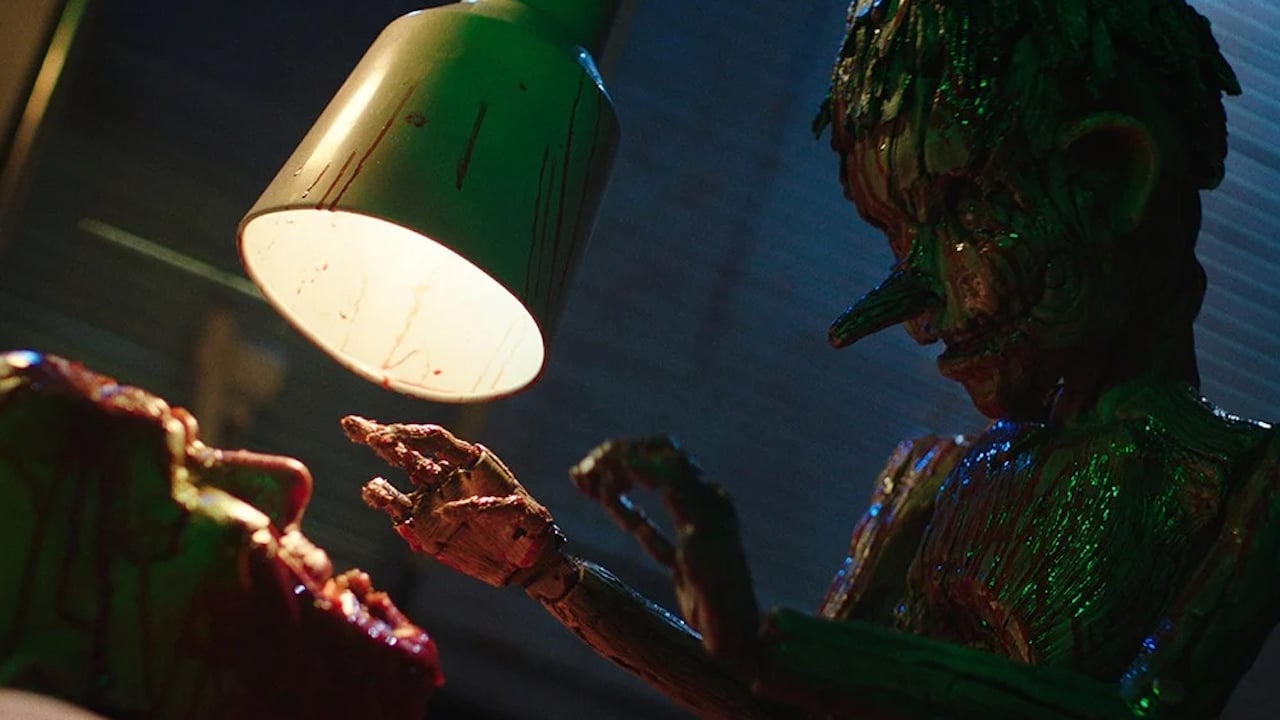
When it comes to Pinocchio himself, the titular puppet’s design initially feels a little lacking, albeit still creepy. Fortunately, it actively improves throughout the film as Pinocchio builds upon his anatomy and “becomes” more human. It also doesn’t hurt that Jude Evan Lloyd is actually a competent actor and a worthy foil for Pinocchio.
Most importantly, it looks like a real movie and features some compelling lighting, which is more than what some of the earlier Twisted Childhood Universe films can claim.
To this point, Pinocchio Unstrung proudly boasts that the film is all done with practical effects and puppetry, which makes such a difference. There’d be no point in even making this movie if it didn’t commit to this practical authenticity. It’s not just a better movie because of this, but it reflects a respect and passion for the craft that’s lacking in other TCU entries. It’d be very easy to cut corners here, and so it’s appreciated that it puts in the effort and goes the extra mile. There’s also a really effective shadow puppetry introduction that’s reminiscent of 2021’s Candyman and a great way to kick off the movie.

Pinocchio Unstrung gradually finds its rhythm and confidence as it goes on, just like a young boy who is figuring out his way in the world. It develops a genuine personality by its end, and there are some weird, unique scenes that really unexpectedly go off the rails and transcend anything from the other TCU films. The place that the film ends is legitimately shocking and feels completely different than the type of movie that’s initially teased. This sort of radical pivot is worth it and turns Pinocchio Unstrung into something weird and wonderful, even if a lot of it still doesn’t work. It deserves credit for taking such big swings, even when they’re unsuccessful.
Those who were left empty from Winnie the Pooh: Blood and Honey and its various offshoots may be pleasantly surprised by this. It actually manages to say something about identity, morality, autonomy, and rising above the expectations that are placed on us, which seems like an insane thing to say for a film like this. It’s a morbid, mindless way to spend 80 minutes.
By the end of this experience, Pinocchio Unstrung transforms from a wooden concept into a real horror film.
Pinocchio Unstrung releases in theaters on July 24, 2026.


You must be logged in to post a comment.