Editorials
Set Report Part 2: ‘The Walking Dead’ Zombies Invade the ATL

It’s time to head down to the smoldering heat of Atlanta, GA with Bloody Disgusting’s Jeff Otto as he reports in with his second of four The Walking Dead set pieces. Airing this October on AMC, the pilot episode was directed by Frank Darabont with six episodes locked for the first season. The Robert Kirkman adaptation follows a group of zombie apocalypse survivors just trying to survive, and find a new place to start over.

PREVIEW | PART 1 | PART 2 | PART 3 | PART 4
 These days, it’s a pretty rare occurrence to shoot exactly where a script is set. Vancouver doubles for New York. Montreal is London. Louisiana becomes for L.A. So on and so forth. But Georgia has been making headway of late in the motion picture industry, offering a sizable tax break good enough to lure fellow horror productions ZOMBIELAND, THE CRAZIES and QUARANTINE 2. When Darabont, Hurd and AMC started putting together WALKING DEAD, Atlanta was the logical choice.
“Atlanta was just the close city, that’s really all it was,” says Kirkman of the setting for the series. “The opening issue takes place in Cynthiana, KY which is where I went to high school and lived a good portion of my life. At the beginning, they talk about how some of the people in neighboring states would have gone to larger cities so they could fortify them and protect the population. So Atlanta’s only six hours away from where I lived and I figured it would be like New York, Atlanta, Miami, maybe Chicago, they would protect those and kind of funnel people in there.”
“Whenever you’re producing, the best possible scenario is to film it where it’s set,” says Hurd. “And then I also had experience shooting in Atlanta on a Lifetime TV movie, so I already knew the crews here were fabulous.”
On the negative side, the heat index on set during our June visit pushed the temperature to over 100 degrees with humidity. “We just suck it up,” says Hurd.
“You don’t get used to the heat,” Darabont admits as he wipes sweat from his brow. “I’ve never had clothes stick to me like this in my life.”
“It’s becoming a running joke is that people arrive on set ready for the day and then they are battered and beaten up by the weather,” says Lincoln. “It’s kind of the right of passage on this job, but it’s great. It makes it real. There’s a lot of hard-earned sweat on camera. It’s not comfortable and it’s not pleasant, but it’s as you would imagine it would be trying to survive in this world.”
Fortunately, the zombies don’t mind too much and Atlanta’s got plenty of walking dead at the ready, including one of the nation’s largest zombie walks. “I don’t think there’s anywhere in the world where you could find better zombie extras,” says Gale. “They are amazing.”
“The people that are playing the walkers are incredibly committed,” adds Lincoln. “They get in very early and they have long hours. All the sequences that I’ve had to do with the walkers have been amazing. They’re so charged for it.”
The production held an open casting call to locate the best and the brightest local undead. And once the right men, women and whatnot were assembled, they headed to zombie school to prep for production.
“We actually spent three days and auditioned everybody,” says Nicotero of the zombie casting. “It was interesting because I initially thought my experience with zombie movies is you just let them do whatever they want to do. George [Romero] always said, ‘You show 50 people one movement then you have 50 people doing all the same thing.’ So we sort of just lined them up and said, ‘Let’s see what your zombie walk would look like,’ and then they would do it and we would say, ‘Try this or try that.’ You know, sort of fine tuning everybody.”
“You learn what your motivation is,” adds Hurd. “We’re hungry, we want to eat. And the fact that not everything is working quite properly. We talked about the inspiration being not the super fast zombies, but the cemetery zombies in NIGHT OF THE LIVING DEAD. They can get up to kind of a jog.”
Both Darabont and Nicotero, who has worked with Romero several times, are zombie purists. In their mind Romero’s zombies are the bible by which all others should be judged. “It’s not that I’m against [fast zombies],” says Nicotero, “it’s just not what I grew up with. It’s interesting too because a couple takes we did where a couple of the zombies kind of broke into a run and after one take Frank’s like, ‘Did they run too fast? They shouldn’t be running. Slow them down.’ This is trying to be creepy and moody and, you know, you’re building up all this kind of scary tension.”
Kirkman promises the show will have some easter eggs for fans of the series paying attention, but you won’t be seeing him amongst the undead any time soon. “I have decided that I do not want to [be a zombie], simply because I don’t like myself,” says Kirman. “It’s a problem I have. I can’t wait to sit down and watch the finished pilot. If I were to walk by on that screen sometime, it would just ruin the whole show for me.”
From what we saw both live on set and in images from the production, the zombies look simply stellar. We’ve seen great work from Nicotero before, but he’s truly outdone himself here, especially considering the time constraints of shooting a television show compared to a feature. When the dead hit your TV on AMC this October, prepare to be disgusted (in a good way).



Auteur Filmmaking is a term that gets thrown around a lot these days in reference to big name directors like Quentin Tarantino and even Wes Anderson, but the truth is that film is a collective medium, and no one person can be responsible for every single aspect of a particular production. However, the smaller a film’s budget, the bigger the individual impact of every creative decision behind it – and the easier it becomes to identify a genuine auteur.
This isn’t necessarily a judgement of value, as blockbuster filmmaking comes with its own challenges and a good movie remains a miracle regardless of how big the crew is, but I’ve always been more interested in soulful b-movies produced by handfuls of passionate artists than blockbusters backed by creative armies.
That’s why I love exploring low-budget franchises that never left the hands of their original creators, as you really get to know the artists involved with these flicks and can accompany their evolution over a period of time. With that in mind, I’d like to invite readers to join me in this multi-part series as we look into a vampire saga helmed by one of the most fascinating auteurs of the 1990s. Naturally, I’m referring to Ted Nicolaou’s criminally underrated Subspecies!
The Birth of an Unlikely Horror Franchise

A proud graduate of the University of Texas’ Film program, Nicolaou got his start in the industry as a sound technician working on Tobe Hooper’s original Texas Chain Saw Massacre. From there, the filmmaker would go on to work for notorious indie producer Charles Band, the founder of both Empire Pictures and Full Moon Productions. According to Nicolaou, Band would usually contact him with an offer to direct a feature after more prominent filmmakers, such as the late, great Stuart Gordon, had already refused, meaning that his projects tended to have lower budgets and more inexperienced crew members.
The plans for Subspecies began almost immediately after the fall of Romanian dictator Nicolae Ceaușescu, with screenwriter David Pabian turning in an initial draft of the film after a Romanian producer contacted Band and explained that Romanian tax incentives could cover the cost of film production there so long as Full Moon took care of the post-production process. Since Stuart Gordon was unwilling to travel to Romania, Ted Nicolaou ended up taking over the picture.
However, while the financial incentives meant that this Romanian-American co-production could look and feel much more expensive than it really was, with Nicolaou scouting for locations in advance and selecting real castle ruins to be featured in the movie, the director was soon faced with an incredibly difficult shooting process. In interviews, Nicolaou would later describe the experience as something of a nightmare, with language barriers and the generalized distrust of capitalist outsiders sabotaging many of the team’s plans for the film.
In fact, the script, which had already been altered by Band, ultimately had portions of it rewritten by both Jack Canson and Nicolaou himself in an attempt to adapt the story to their unique limitations.
Radu Is One of Horror’s Greatest Underrated Villains

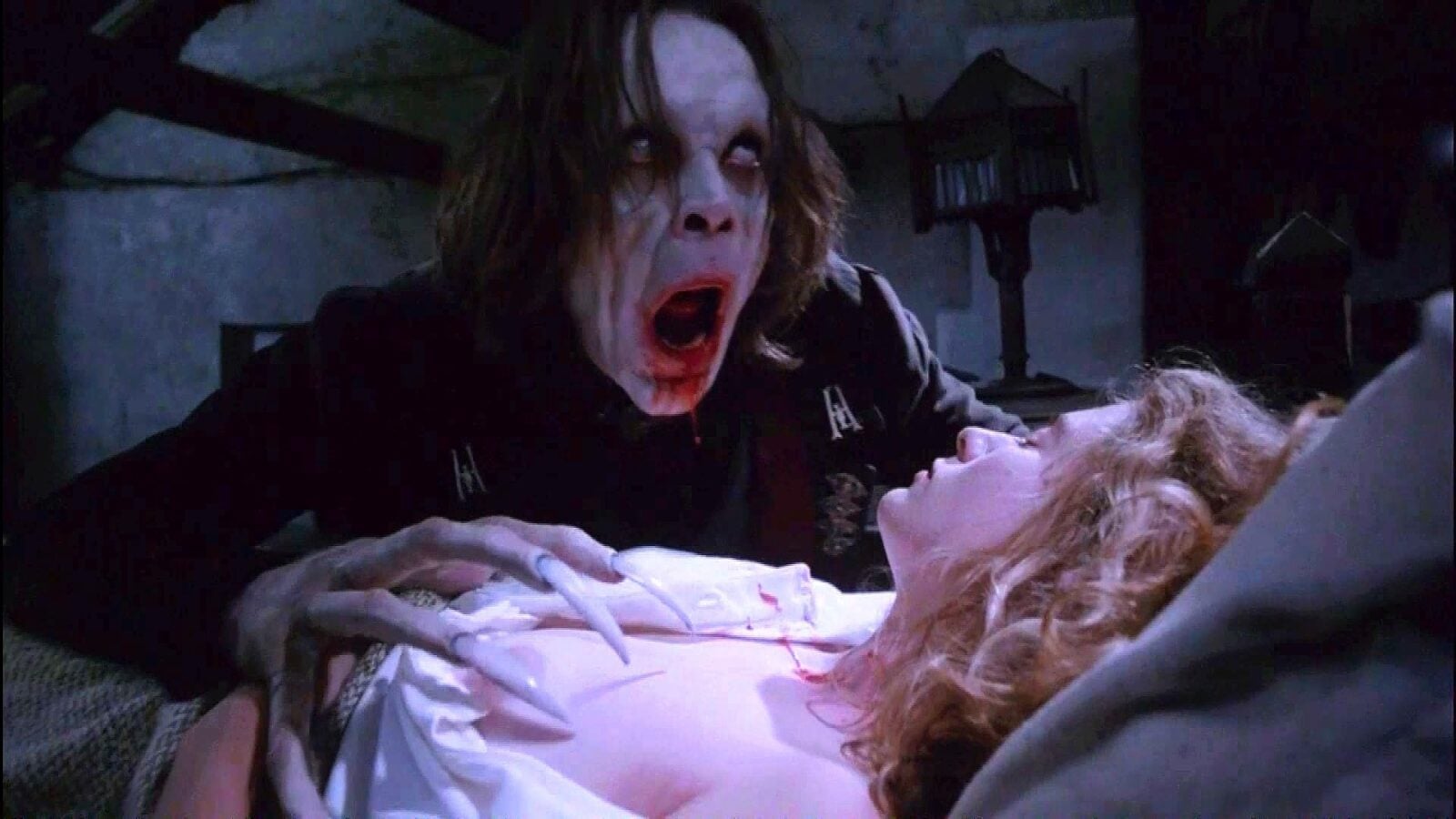
In the finished film, which was released directly to video in 1991, we follow a pair of American anthropology students, Michelle (Laura Mae Tate) and Lillian (Michelle McBride), as they reunite with their Romanian colleague Mara (Irina Movila) in her native land. The group intends to study the folklore surrounding the secluded town of Prejmer, but their research is cut short by the return of Radu Vladislas (Anders Hove) – the evil son of a vampire king (Angus Scrimm) who had previously established a truce with the region’s human residents. It’s now up to Radu’s human-loving half-brother Stefan (Michael Watson) to protect the girls from a fate worse than death as the power-hungry vampire seeks to control a magical artifact known as the Bloodstone.
Right off the bat, you may have noticed that the film’s premise sounds decidedly old-fashioned when compared to other vampire movies from around the same time. While the 1990s saw the rise of cool-looking bloodsuckers with badass elements borrowed from Westerns, as well as the sexy aristocrats of Anne Rice’s stories, Subspecies has a lot more in common with Nosferatu and the Hammer Horror series than any of its contemporaries.
This is both a blessing and a curse, as the film falls victim to overly familiar genre tropes while also standing out as a rare example of a ’90s vampire flick that isn’t afraid to flex its muscles as a Creature Feature. In fact, I’d argue that the presence of age-old clichés is a small price to pay when confronted with one of the most compelling vampire antagonists in all of cinema.
Named after Vlad the Impaler’s real-life brother, Anders Hove’s Radu is such a fascinating character and the main reason why Subspecies is still worth watching 35 years later. From his animalistic mannerisms to the joy he feels in simply existing as a chaotic creature of the night, and that’s not even mentioning the iconic makeup that almost certainly inspired the undead from Buffy the Vampire Slayer. Radu is a hypnotic presence harkening back to a time when audiences didn’t mind purely evil villains that couldn’t be redeemed through tragic backstories or sex appeal.
Gothic Atmosphere on an Indie Budget

Of course, the film’s Romanian setting and authentic art direction do a lot of the heavy lifting whenever Radu isn’t around. From the masked festivals of the village to the visually interesting selection of local extras, Subspecies’ multicultural elements help it to stand out when compared to similar flicks from the ’90s.
That being said, Nicolaou’s unique eye for special effects and exciting action sequences – as well as Vlad Paunescu’s excellent cinematography – make the movie a delight for fans of expressionist cinema and old-timey gothic horror. While the crew is obviously dealing with limited resources, many of the flick’s blemishes (such as the odd stop-motion demons that serve Radu) end up feeling more like charming idiosyncrasies than actual flaws.
I’d argue that the only real issue here is pacing, as there are long stretches of film where the protagonists are simply bumbling around without realizing what’s really going on around them. Thankfully, the gorgeous visuals and surprisingly effective soundtrack usually make up for this. Besides, how can you dislike a movie where shotgun shells are loaded with rosary beads and our lead vampires duke it out in a dramatic swordfight that would feel out of place during the golden age of Hollywood?
Your overall enjoyment of Subspecies will mostly depend on whether or not you find low-budget corner-cutting and janky practical effects charming rather than distracting, but I know I’ll keep coming back to this Full Moon feature again and again in the future.
That being said, while this first movie is worth revisiting by its own merits as the birth of an indie horror icon, I’d like to invite you to join us as we look into the cult sequel Bloodstone: Subspecies II soon.
You must be logged in to post a comment.