Editorials
E3 2015 Horror Game Wish List


Hide the children, it’s almost time for the latest installment in our annual celebration of all things video games and the last thing you want getting between you and the deluge of headlines we’re about to witness is a son or daughter who isn’t capable of appreciating this wondrous occasion because they’re too busy crying about how you haven’t taken them for a walk in three days, or whatever it is parents do with their kids.
The Electronic Entertainment Expo is that magical time of year when the makers, sellers and buyers of video games flee their homelands to journey to the City of Angels for four straight days of gaming goodness. Without E3, June would be the second worst month of the whole year, beaten only by the absolute worst month, which we all know is August. August sucks.
I’m sure you don’t remember my wish lists from previous E3’s — and if you do, you’re an X-Man and you should really consider finding a better use for your gift because memorizing old articles of mine is both weirdly specific and an entirely useless ability in the grand scheme of life — but for all you non-mutants, you should know that what I want rarely matches up with what we get.
Let’s see if I can keep that streak going with this year’s wish list.
These games are in no particular order, but if they were, the Friday the 13th game would likely claim the #1 spot. We’ve seen nary a screenshot or second of gameplay footage from this one, leading me to believe it won’t be hitting the October release date they originally promised.
Aside from Until Dawn, which I’m sure will be shown in some capacity, the only other slasher game I see coming this year is Slasher Vol. 1: Summer Camp, which, like F13, is an asymmetrical multiplayer game in which a player-controlled psychopath must hunt down a team of player-controlled teens.

Even more of an enigma than the F13 game is Sony Bend’s oft-rumored project. Rumor has it it’s an open-world survival horror game. It’d be great if that were true, so long as it has nothing to do with zombies. We have plenty of those to choose from now thanks to Dying Light, Resident Evil, Dead Island 2, DayZ and H1Z1, as well as at least two more Walking Dead games. I’m not tired of the undead, I’m just craving a reprieve from the constant smell of rot.
Before State of Decay even had a name — it was first announced under the code-name Class 3 — developer Undead Labs has been open about their plans to use it as the foundation for an even more ambitious open-world zombie game, code-named Class 4.
With the obligatory XBO port of State of Decay finally behind them, the studio is free to focus completely on the next big thing. I can’t imagine they’ll have anything substantial to show off in time for E3, but there’s a chance we may get a CG trailer. I’d also settle for a title.
Dead Island 2 may take the stage this month, but the smarter move would be to save the good stuff for Gamescom in September, or possibly even whatever this year’s incarnation of The Game Awards ends up being called. I can’t say that I’m looking forward to watching those for another year, even with the world premieres the show brings with it. That won’t keep me from enduring them again, because you’re worth it.
The only other high profile zombie games I’d like to hear from belong to Capcom. The focus should stay on the Resident Evil 0 remaster that’s coming later this year. However, if Capcom really wants to impress, they might mention Resident Evil 7. I assume they’ll want to follow up the success of Revelations 2 with another episodic game, which may mean more Revelations for us.
And with that, Resident Evil concludes the itchy, tasty portion of this wish list.

On the supernatural front, we have the possibility of an Alan Wake remaster, a Western release for Fatal Frame V and, if we’re lucky, we’ll hear something from Frogware’s Call of Cthulhu game. That one has been quiet for awhile. Games that are based on the works of H.P. Lovecraft have had a rough time staying out of development limbo, so even a “Yes, it’s still on the way” statement from Frogware would be fantastic.
Is Draugen a supernatural horror game? Whatever it is, it’s been quiet long enough that I’m beginning to worry about its health. Developer Red Thread Games has said they’d like to crowdfund it, potentially for a 2015 release. Mid to late 2016 is looking more likely as far as a release window, and that would give them plenty of time to raise some funds to help realize it. Until then, some new footage would be a swell way to remind us Draugen still exists.
Kodoku is one of those rare sorts of video games that can be immediately identifiable solely because of a distinctive art style. I’m not sure what the official term for it is, or if there even is a term to describe this delightfully strange-looking game. I also don’t think it’s necessary.
What’s more important is that you approach this interactive acid trip like you would a real one and make sure you have a safe place to play it in, and that you surround yourself with people you trust.
Before we go, here are a few miscellaneous things I’d also like to see at E3:
– Release dates for Predator in Mortal Kombat X, The Forest (PS4), DayZ (PS4) and Grave (XBO)
– A look at that upcoming Bloodborne expansion
– What’s next for Creative Assembly (Alien: Isolation) and Tango Gameworks (The Evil Within)
– Literally any news regarding the future of Condemned, Dead Space and Silent Hill
– For Konami to spend their entire conference apologizing to us for everything they’ve done. They can open with a heartfelt speech, followed by some crying, then Kojima needs to come on stage and kick a Konami exec in the balls, followed by even more crying. It will all end with a surprise appearance from Guillermo del Toro where he looks directly into the camera to tell me, personally, that everything is going to be okay.
– To not have to mention Left 4 Dead 3 in next year’s list.




Editorials
Before ‘The Odyssey’ There Was ‘Jason and the Argonauts’ and Ray Harryhausen’s Legendary Monsters

Greek mythology is the talk of the town, or at least of the internet at the moment, and with good reason. Christopher Nolan’s retelling of Homer’s The Odyssey opened this weekend in theaters and, as of this writing, is on track to rake in $120 million in the U.S. and $250 million worldwide.
That’s quite a feat for an R-rated sword and sandal epic based on a story that was first put to papyrus over 3,000 years ago. Of course, mythology has been a film standard practically since the beginning of the medium and has proven to be fertile ground for storytellers. One of the great tellers of these tales is not a writer or director but an innovative special effects master and producer, Ray Harryhausen, and among his greatest achievements is Jason and the Argonauts (1963).
The story of Jason and the quest for the golden fleece predates the Homeric period by a generation or two, and there are certainly similarities to the later works, specifically The Odyssey. Both are seafaring adventures captained by men of both strength and wit. Their crews are filled with colorful characters as well, including Hercules and Argos in the Jason tales and Eurylochus and Polites among Odysseus’s men. Both encounter the beautiful and bizarre on their journeys. The major differences are in tone and theme. The Odyssey is a more contemplative piece about men of war finding it is practically impossible to truly return home.
Jason and the Argonauts, especially in the hands of Harryhausen, producer Charles H. Schneer, director Don Chaffey, and writers Beverly Cross and Jan Read, is a tale of adventure, romance, betrayal, gods, and perhaps above all—monsters.
Strictly speaking, nearly all the Harryhausen films are fantasy films, but all are filled with some of the most incredible monster creations in all of cinema. Telling mythological stories was a way of making monster movies that parents would not object to their children seeing. That whiff of the movie-going experience being educational gave him license to bring to life dozens of indelible creations, starting with The 7th Voyage of Sinbad in 1958 all the way to Clash of the Titans in 1981. So, rather than spoil the story of Jason and the Argonauts, I will be focusing on its main attraction, its unforgettable monstrosities.
Talos: The Bronze Giant That Changed Movie Monsters

After Jason (Todd Armstrong) and his crew set off on their quest aboard the Argo, they quickly find themselves running out of food and water. Calling upon the help of his protector Hera, Queen of the Gods (Honor Blackman), Jason is guided to the Island of Bronze but warned not to take anything from the island but food and water. While chasing a herd of goats, unlikely pals Hercules (Nigel Green) and Hylas (John Cairney) discover the gargantuan bronze statues of the gods and Titans created by the long-departed Hephaestus.
In the base of the statue of Talos, they discover the treasure trove of the gods, and Hercules decides to take a giant golden needle that he intends to use as a javelin. Of course, this awakens Talos, who pursues them back to the Argo.
Talos was one of Harryhausen’s favorite creations, and he reveled in giving life to the stiff movements of the man of bronze. In one sequence, Talos blocks the narrow waterway that is the only means of escape and plucks the Argo out of the sea as though it were a toy, shaking the crew overboard and breaking the mast in two. Jason once again asks Hera for help, and she advises him to “look to the ankles” of the statue. He spots a kind of hatch on the heel of the giant and, after much struggle, removes it, releasing a flow of steaming liquid that is apparently the driving force of Talos, who weakens, cracks, and falls to the beach, breaking into pieces.
Echoes of this scene can be found in all kinds of stories from Achilles’ heel to the small vulnerable spot on Smaug’s belly in The Hobbit, to tangling the legs of the Imperial AT-AT’s in The Empire Strikes Back. Even the Death Star has a touch of Talos to it.
Harryhausen’s Harpies and Hydra Bring Ancient Myth to Life

Next, the Argonauts encounter the old man Phineas, played by Patrick Troughton of Dr. Who (he played the Second Doctor) and The Omen (1976) fame. As punishment for sins that go unnamed in the film, Zeus torments Phineas day and night with harpies who steal his food and leave him only scraps.
The harpies are flying, blue, rather demonic-looking creatures complete with bat wings and horns. They look something like living gargoyles and are masterworks by Harryhausen. The crew lures them into the ruins of a temple and covers the entire structure with a net before releasing the top and snaring the harpies. The stop-motion work in this sequence is some of the best Harryhausen ever created and is seamlessly placed into frame with the live-action elements, as was among Harryhausen’s greatest strengths.
The special effects of the film use every tool available at the time, as demonstrated by the next major effects sequence, “the clashing rocks.” The sequence utilizes stop motion, miniatures, rear projection, location and stage work with the actors all blended together, sometimes into a single shot. The clashing rocks are more-or-less a rock slide, but combined with the destruction of a different ship that tries to make passage between the rocks and the knowledge that Hera is now forbidden to interfere with Jason’s fate, real stakes are afforded to the scene. Hera pulls a fast one on Zeus (Niall MacGinnis), however, which allows Triton, king of the Mer-people, to rise from the sea and stabilize the rocks, giving the Argo safe passage.
The crew then rescues Medea (Nancy Kovack) and heads to their final destination, Colchis at the end of the world, where Jason and the Argonauts are welcomed by King Aeetes (Jack Gwillim). Eventually, after a betrayal and turn of events, Jason finds the golden fleece, which is guarded by another great Harryhausen monster, the Hydra, a multi-headed serpent. The most famous aspect of the Hydra, growing back two heads for every one cut off, is not depicted here, but the sequence is still harrowing.
Jason fights the dragon with his sword and at one point is wrapped in its tail, depicting Harryhausen’s love of intercutting and interrelating his stop-motion creations with actors and other live-action elements. The sequence also demonstrates that the artistry of Harryhausen and the craftspeople in his workshop was not limited to fantasy creatures; they were also masters of recreating believable human figures.
Why Harryhausen’s Monsters Still Feel Alive

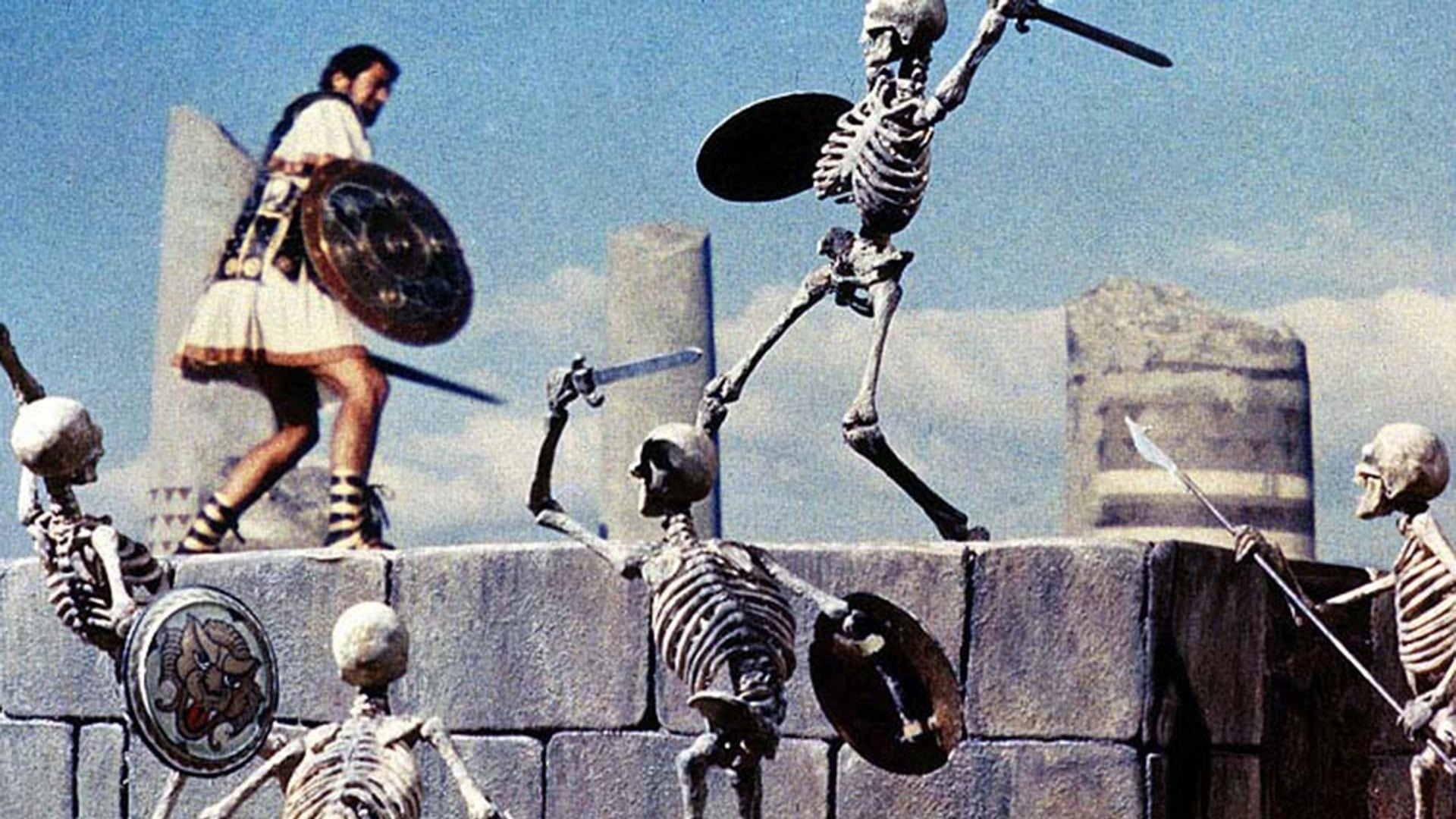
Perhaps the most famous Harryhausen creation, the one that has had the greatest lasting influence, is what is called in the film the “children of the hydra’s teeth” and the “children of the night” by Aeetes, who calls on the goddess of darkness Hecate to bring them to him. Fire rains down from the sky and reduces the hydra to a skeleton. Aeetes orders his men to gather its teeth, which he collects in a helmet and, cornering Jason and his men, sows on the ground like seeds. Reanimated skeletons of dead soldiers rise up out of the ground and attack the Argonauts in what is certainly one of the most iconic sequences in all of fantasy cinema.
It is an expansion of a similar scene in The 7th Voyage of Sinbad in which the fearless sailor fights a single skeleton, but this time there are more than half a dozen reanimated warriors complete with the famous “Harryhausen brow,” in which the empty eye sockets are given a sinister frown. Even today, the sequence is thrilling. Though our technology has given us tools that look more realistic, there is a magic in stop-motion that remains unmatched despite all our advances in CGI.
This sequence has directly influenced many movies over the years, but for the horror crowd, the clearest examples are Freddy’s skeleton fighting Donald Thompson (John Saxon) in A Nightmare on Elm Street 3: Dream Warriors (1987) and the deadite army in Army of Darkness (1992). The animators even included the slouch of the “children of the hydra’s teeth” in the Nightmare 3 scene, and Sam Raimi insisted the Army of Darkness skeletons all have the Harryhausen brow.
Beyond these films, Harryhausen’s work has had a massive influence on horror, fantasy, and science fiction films for decades, while also making an indelible mark on popular culture at large. Among his acolytes are stop motion genius Phil Tippett, and filmmakers including Joe Dante, Guillermo del Toro, Peter Jackson, George Lucas, Steven Spielberg, John Milius, Don Coscarelli, and many others. The fingerprints of Harryhausen can in many ways be seen even in Nolan’s The Odyssey, which relies on tricks from throughout film history rather than only more recent innovations like CGI.
Above all, Harryhausen was a storyteller who sought to make audiences fall in love with the great adventure stories that have been with us for thousands of years. These stories speak to the heart of our humanity in ways that will always feel fresh when told in innovative ways. Harryhausen also always had in him the true joy of creation. Bringing his monsters to life was a long, sometimes tedious, process, but Harryhausen clearly understood that all that time and attention to detail would imbue every creation with humanity that cannot be replicated by taking the easy way around.
Despite the limitations of budget, star power, and other resources that his films often lacked, that love of storytelling always shone through. Perhaps that is why his creations endure along with the kinds of ancient stories he so loved to tell.
At their heart, they are one thing above all—deeply and undeniably human.
You must be logged in to post a comment.